


Pilot Scale Fermenter for Reliable Scale-Up
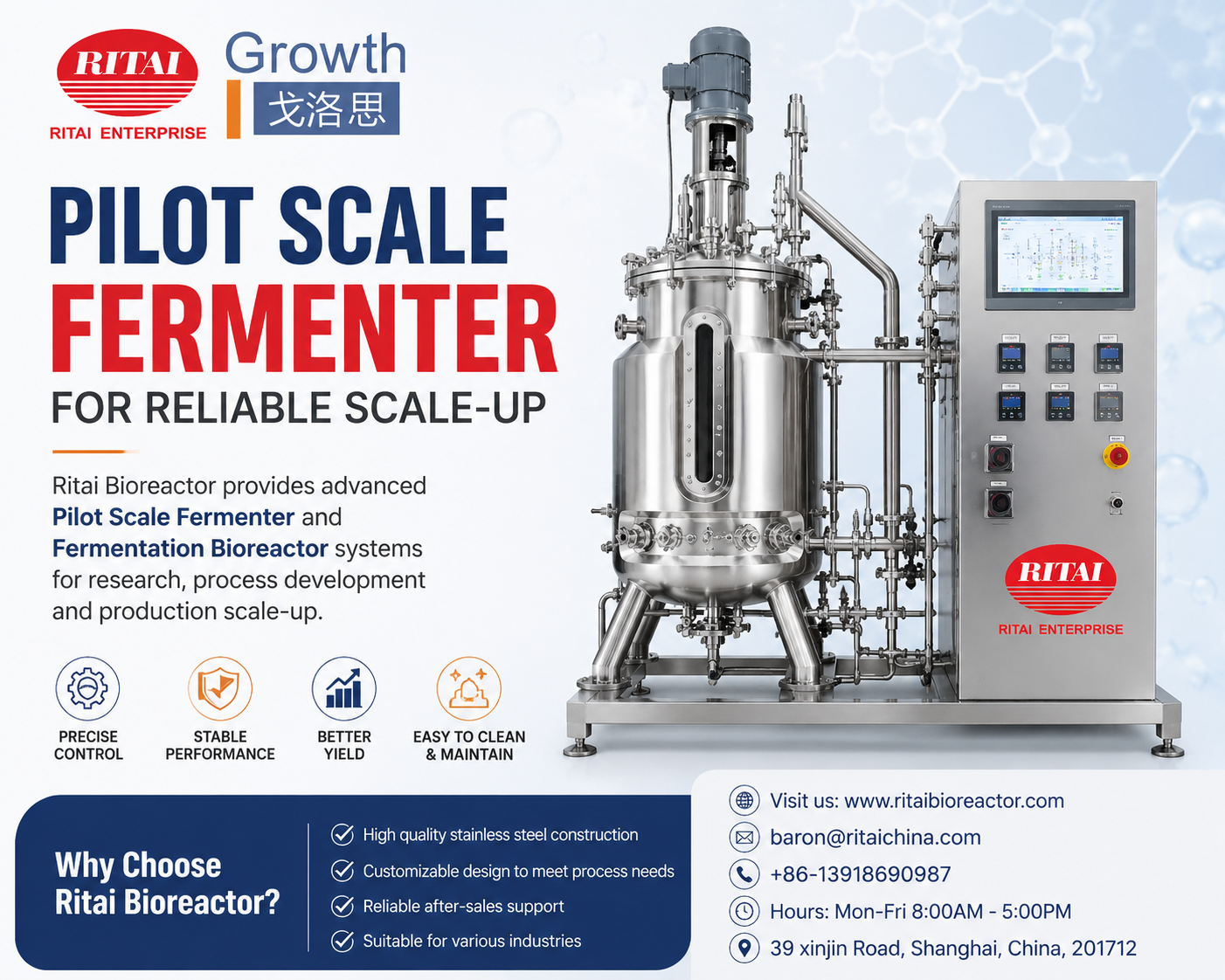
A Pilot Scale Fermenter is an important step for any company or research team that wants to move from lab testing to real production. In biotechnology, pharmaceuticals, food processing, enzymes, probiotics, and vaccine development, small lab results are not enough to prove that a process will work at a larger level. This is where a reliable Fermentation Bioreactor becomes useful. Ritai Bioreactor in China provides practical fermentation systems designed to support testing, process development, and scale-up with better control and confidence.
What Is a Pilot Scale Fermenter?
A Pilot Scale Fermenter is a controlled vessel used to grow microorganisms, bacteria, yeast, fungi, or cell cultures at an intermediate production level. It is bigger than a laboratory fermenter but smaller than a full industrial fermenter. The main purpose is to check whether a process developed in the lab can perform well at a higher volume. When a batch moves from 5 liters to 100 liters or 500 liters, many things change. Mixing becomes harder, oxygen transfer behaves differently, heat control becomes more important, and foam formation can increase. A Pilot Scale Fermenter helps teams study these changes before investing in large production equipment.
Why Pilot Scale Fermentation Is Important
Many fermentation processes look successful in the laboratory, but they may not give the same result during scale-up. For example, a bacterial process may need more oxygen at a larger volume. A yeast fermentation may produce more foam. A pharmaceutical process may need tighter temperature and pH control. Using a Fermentation Bioreactor at pilot scale helps operators collect real process data. They can monitor pH, dissolved oxygen, agitation speed, airflow, temperature, pressure, feeding rate, and product yield. This data helps reduce production risk. Instead of making decisions based only on theory, companies can test the process under practical conditions.
Key Features of a Good Pilot Scale Fermenter
A good Pilot Scale Fermenter should be strong, accurate, and easy to operate. The design should support stable growth and repeatable results.
Important features include:
- Stainless steel vessel construction
- Accurate temperature control
- pH and dissolved oxygen sensors
- Agitation and aeration control
- Foam control system
- Feeding system
- Sampling ports
- Sterilization support
- CIP and SIP options
- Safe pressure control
- User-friendly control panel
- Data recording system
Ritai Bioreactor designs fermentation systems in China with these practical needs in mind. The goal is to help users manage fermentation smoothly from trial batches to larger production planning.
Pilot Scale Fermenter vs Laboratory Fermenter
A laboratory fermenter is mainly used for early-stage research. It is suitable for strain selection, media testing, and small-batch trials. A Pilot Scale Fermenter is used when the process needs to move closer to real production.
At pilot scale, the process becomes more complex. Mixing time increases. Oxygen transfer may become limited. Temperature control needs stronger engineering. Cleaning and sterilization also become more serious.
A Fermentation Bioreactor at this stage gives a clearer picture of how the process will behave in industrial conditions.
Common Applications of Pilot Scale Fermenter Systems
- A Pilot Scale Fermenter is used in many industries. In biotechnology, it supports microbial fermentation, recombinant protein production, enzyme production, and strain development.
- In pharmaceuticals, it is used for vaccine development, antibiotics, biological products, and process validation. In the food industry, it supports probiotics, fermented ingredients, organic acids, and yeast-based products.
- Agriculture companies also use pilot fermentation for biofertilizers, biopesticides, and microbial products. Research institutes use these systems for training, testing, and applied bioprocess studies.
Why Choose Ritai Bioreactor in China?
- Ritai Bioreactor is a trusted name for fermentation and bioreactor equipment in China. The company provides systems for research, pilot-scale testing, and production-level applications.
- One strong point of Ritai Bioreactor is practical customization. Not every fermentation process has the same requirements. Some users need high oxygen transfer. Some need anaerobic conditions. Some need advanced automation, while others need a simple and reliable system for routine testing.
- Ritai Bioreactor supports different industries with suitable Fermentation Bioreactor designs, helping users choose the right vessel size, control system, feeding setup, and sterilization method.
Things to Check Before Buying a Pilot Scale Fermenter
Before buying a Pilot Scale Fermenter, users should understand their process clearly. Vessel size is important, but it is not the only factor. You should check the type of microorganism, oxygen demand, temperature range, foam behavior, pressure requirement, cleaning method, and future scale-up plan. For bacterial fermentation, dissolved oxygen and agitation are very important. For anaerobic fermentation, sealing quality and gas control matter more. For pharmaceutical use, material quality, documentation, cleaning design, and sterilization reliability are key. A well-selected Fermentation Bioreactor can save time, reduce process failure, and improve production planning.
How a Pilot Scale Fermenter Supports Scale-Up
Scale-up is not just about increasing batch size. A process that works in a small tank may fail in a larger tank if mixing, aeration, or heat transfer is not handled properly. A Pilot Scale Fermenter allows teams to test these factors step by step. Operators can adjust airflow, agitation speed, nutrient feeding, temperature, pressure, and pH control. This helps create a stronger process before moving to commercial production. It also helps companies estimate production cost, batch time, raw material use, and expected yield.
Maintenance and Operation
A pilot fermenter should be easy to clean, inspect, and maintain. Regular maintenance keeps the system reliable and extends equipment life. Common maintenance tasks include sensor calibration, checking seals and valves, inspecting the agitator, testing sterilization performance, and cleaning the vessel properly after each batch. A well-maintained Fermentation Bioreactor gives more consistent results. It also helps prevent contamination, production loss, and unexpected downtime.
Final Thoughts
A Pilot Scale Fermenter is a smart investment for companies and research teams that want to move from laboratory work to real production with less risk. It helps test process stability, improve yield, and understand scale-up behavior before full industrial manufacturing. Ritai Bioreactor in China provides practical fermentation equipment for biotechnology, pharmaceutical, food, agriculture, and research applications. With the right Fermentation Bioreactor, users can build a stronger foundation for reliable production and better long-term results.
FAQs
1. What is a Pilot Scale Fermenter?
A Pilot Scale Fermenter is an intermediate-size fermentation system used to test and optimize biological processes before large-scale production.
2. Why is a Pilot Scale Fermenter important?
It helps companies study scale-up performance, process stability, oxygen transfer, mixing, temperature control, and product yield before commercial manufacturing.
3. What is the difference between a fermenter and a Fermentation Bioreactor?
A fermenter is mainly used for microbial growth, while a Fermentation Bioreactor may include broader biological processes with advanced control systems.
4. Which industries use Pilot Scale Fermenter systems?
Biotechnology, pharmaceuticals, food processing, probiotics, enzymes, vaccines, agriculture, and research institutes commonly use pilot fermenters.
5. Can Ritai Bioreactor customize a Pilot Scale Fermenter?
Yes, Ritai Bioreactor can provide customized systems based on vessel size, process type, control needs, automation level, and sterilization requirements.
6. What size is suitable for a Pilot Scale Fermenter?
Common pilot fermenter sizes may range from 50L to 1000L or more, depending on the process development and production testing needs.
7. Why buy a Pilot Scale Fermenter from China?
China offers strong manufacturing capability, competitive equipment options, and practical customization. Ritai Bioreactor provides reliable Fermentation Bioreactor systems for research and industrial users.

 English
 Arabic
 French
 Spanish
 Portuguese
 Deutsch
 Turkish
 Dutch
Dutch
 Russian
 Romaian
 Portuguese (Brazil)
 Greek
Greek
