


6 Protection Gaps in Quarterback Football Pads (and How to Improve Safety Without Losing Mobility)
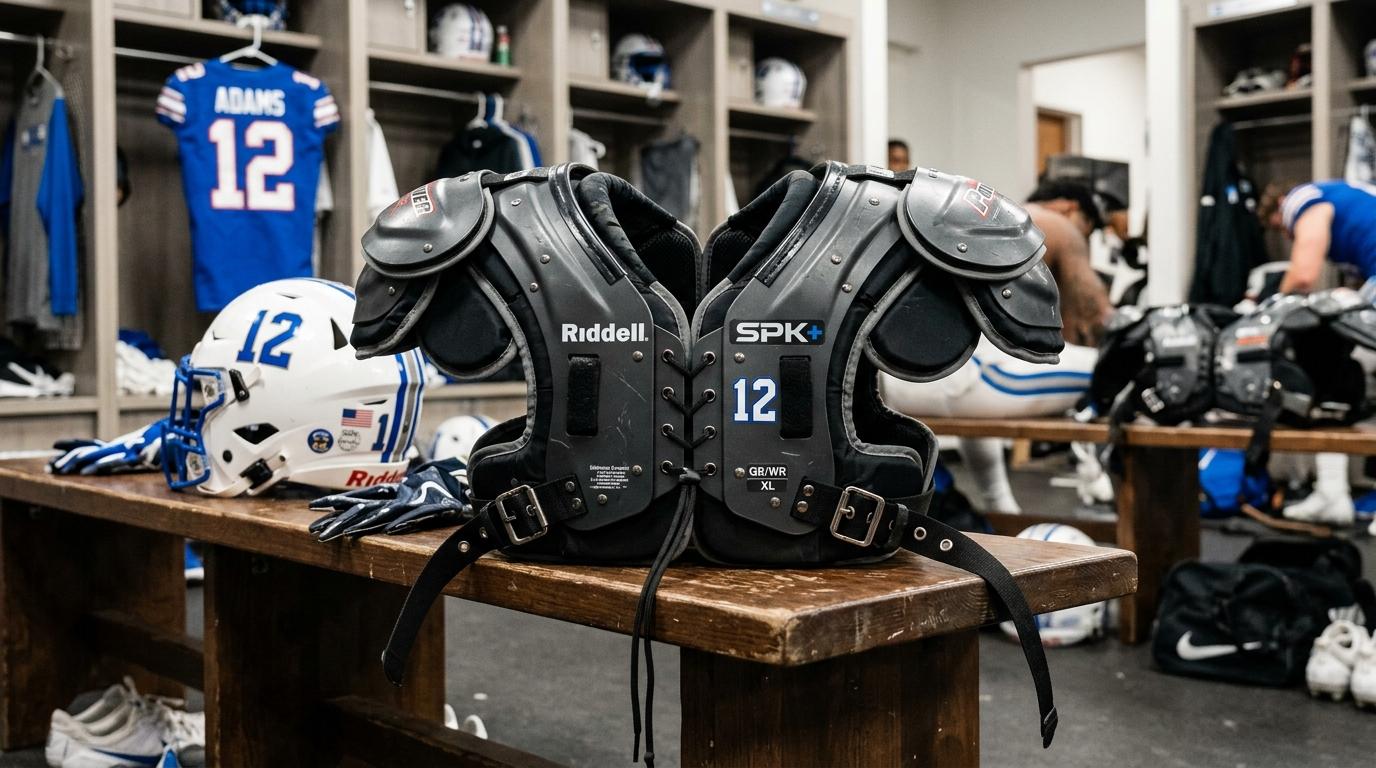
For a quarterback, the field is a balancing act. You need the freedom of movement to drop back, survey the defense, and fire a precise strike into a tight window. Yet, you are constantly vulnerable to high-speed collisions from pass rushers coming from your blind side. Finding the right quarterback football pads is about navigating this razor-thin margin between necessary protection and the unrestricted mobility required for elite performance.
While modern shoulder pad technology has made significant strides in impact absorption, there remain specific anatomical vulnerabilities—gaps in protection—that many standard sets of pads fail to address adequately. Understanding these gaps is the first step toward better safeguarding players and extending their careers. At Tag Sports Gear, we believe that elite performance begins with uncompromising safety.
1. The Clavicle and AC Joint Vulnerability
One of the most frequent injury sites in football is the acromioclavicular (AC) joint. Standard pads often provide decent central chest protection but sometimes fall short in covering the lateral aspect of the collarbone. When a quarterback is tackled or lands awkwardly on their shoulder, the force is often directed straight into this joint.
To bridge this gap, players should look for pads that feature high-density foam integration that extends further over the AC joint, ensuring that impact forces are dispersed away from the vulnerable bony prominences rather than directly onto them.
2. Inadequate Scapular Coverage
The shoulder blades, or scapulae, are often overlooked in standard shoulder pad designs. While the primary goal is protecting the front of the body, a quarterback frequently takes hits from the side and rear. If the padding does not adequately track the movement of the shoulder blades, the back remains exposed to direct impact during a blindside hit.
High-performance gear, like the advanced designs offered by Tag Sports Gear, focuses on kinetic fit—ensuring that even as the quarterback rotates their torso to throw, the rear padding maintains contact with the shoulder blade to provide continuous coverage.
3. The Sternum-to-Pad Interface
The sternum is the central anchor point for a quarterback’s protection. A common gap occurs when the front plate is either too rigid, causing it to "dig" into the chest during high-impact plays, or too loose, failing to absorb enough energy.
The ideal setup bridges the gap between rigid protection and flexible comfort. By utilizing advanced impact-absorbing materials, the pad should feel like a second skin, ensuring the sternum is protected against direct frontal collisions without restricting the thoracic cavity's expansion during breathing.
4. Lateral Rib and Bicep Exposure
The transition area between the shoulder pad and the bicep pad is a notorious "dead zone." Many quarterback pads are designed to be low-profile, which unfortunately often leaves the upper deltoid and the transition to the bicep exposed.
Enhancing safety here doesn't mean adding bulk. Instead, it involves utilizing integrated, anatomical cap systems that move with the arm. This ensures that even during the throwing motion, the deltoid remains shielded from the aggressive, quick-twitch hits that define modern pass rushing.
5. Neck and Trapezius Constraint
While protection is the priority, over-padding the neck area can lead to a dangerous restriction of movement. If a quarterback cannot turn their head efficiently to read a safety or scan the field, their processing time slows down. Conversely, under-padding this area leaves the traps vulnerable to stingers—a common issue that can sideline a quarterback for weeks.
The solution lies in a refined neck-roll integration that provides vertical protection for the traps while allowing for a full range of cervical rotation. This balance is crucial for maintaining both the physical safety of the neck and the cognitive speed required at the line of scrimmage.
6. The "Gap" at the Front Plate Intersection
Standard shoulder pads often have a significant gap where the two front plates meet at the center of the chest. While this is necessary for front-to-back flexibility, it can expose the mid-chest to a direct, powerful hit.
Modern engineering has introduced "sternum plates" that overlap or feature bridge-foam inserts to close this gap. By selecting pads that feature a closed-system sternum design, quarterbacks can ensure they don't have a structural weak point right in the center of their torso.
How to Optimize Safety Without Losing Mobility
The goal is never to turn the quarterback into a defensive lineman; it is to maximize coverage while maintaining a low profile. Here is how you can optimize your setup:
-
Prioritize Anatomical Fit: Do not settle for "one size fits all." Ensure the pad matches your specific shoulder width and torso length.
-
Check the Range of Motion: Before stepping onto the field, simulate your throwing motion. If the pads pinch or restrict your follow-through, you need an adjustment in the strap settings or a different profile.
-
Use Advanced Materials: Look for pads that utilize modern polymers and closed-cell foams. These materials absorb energy more efficiently than traditional padding, allowing for a thinner, more mobile profile that provides the same—or better—protection.
-
Regular Inspections: Pads degrade over time. Check your equipment for cracks, loose straps, or compressed foam that no longer rebounds.
Conclusion
Quarterbacks are the engines of their teams, and protecting them is paramount. By identifying these six protection gaps—from the AC joint to the center sternum—players and coaches can make more informed decisions about the gear they choose. You do not have to sacrifice mobility to be safe. By focusing on ergonomic design and advanced material science, you can ensure that you stay on the field, focused on the game rather than the threat of injury.
Frequently Asked Questions
Q: Do heavier shoulder pads always provide better protection for quarterbacks?
A: Not necessarily. In modern football, protection is more about the quality of the impact-absorbing material and the anatomical fit than the overall weight of the pad. Heavier pads can actually decrease mobility and increase fatigue, which might hinder a quarterback's performance.
Q: How often should a quarterback replace their shoulder pads?
A: Generally, you should inspect your pads at the start of every season and periodically throughout the year. If the padding has lost its "bounce" (remains compressed), the shell is cracked, or the straps no longer hold the pad securely in place, it is time for a replacement.
Q: Can I customize my shoulder pads to close these protection gaps?
A: Many players add "accessories" like neck rolls or additional rib protectors. However, it is best to start with a pad designed with high-coverage in mind to ensure the integration is seamless and doesn't interfere with your throwing mechanics. Always prioritize gear that is designed to work as a complete, cohesi

 English
 French
 Spanish
 Portuguese
 Deutsch
 Turkish
 Dutch
Dutch
 Italiano
 Russian
 Romaian
 Portuguese (Brazil)
 Greek
Greek