


Surgical Instruments Manufacturers in India for Cardiac Care
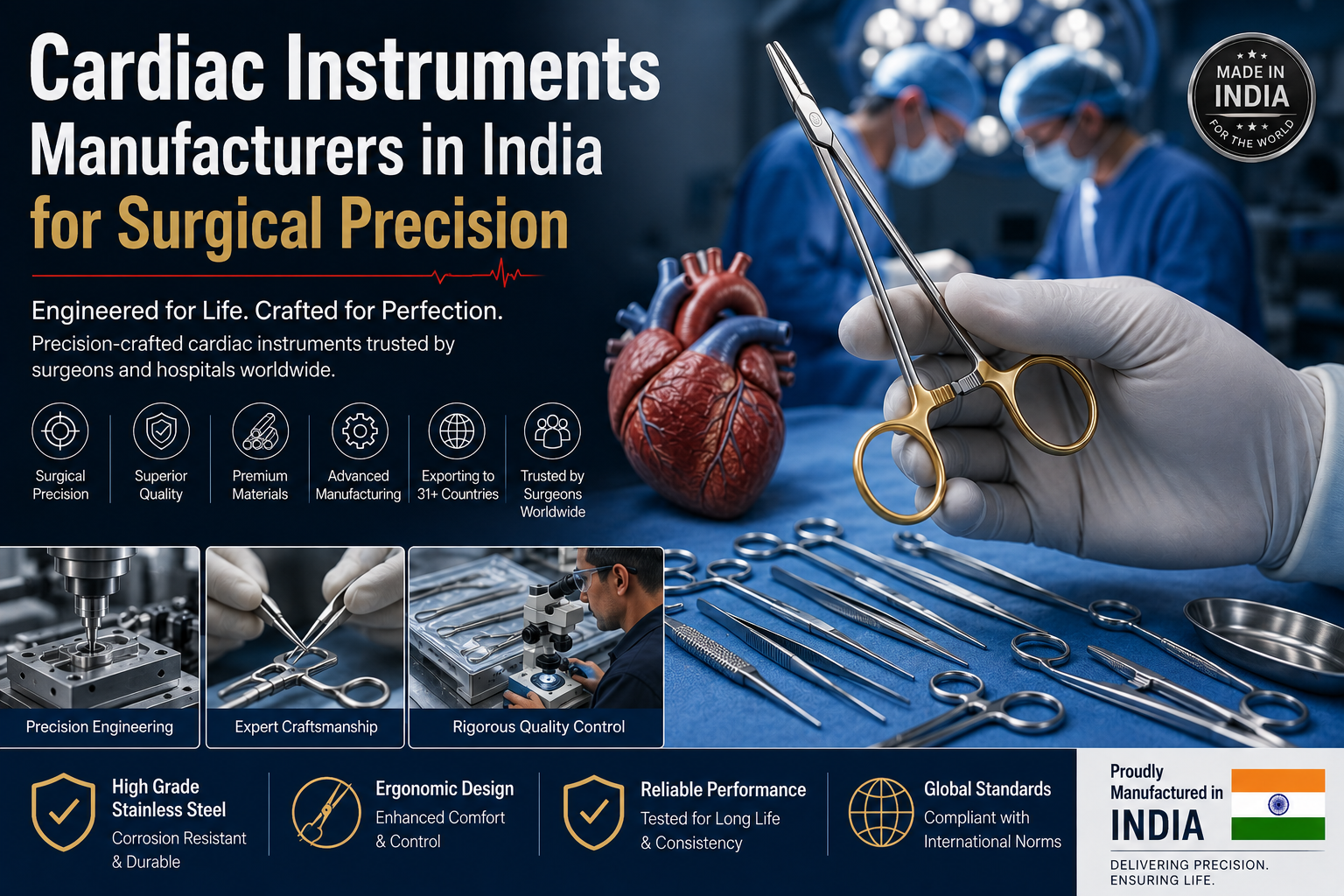
How Cardiac Instruments Manufacturers in India Support Modern Surgical Excellence
Cardiac procedures fail for small reasons more often than hospitals admit. A clamp that loses grip after repeated sterilization cycles. A needle holder with inconsistent tension. Surgical instruments that looked acceptable in a catalog but create fatigue during a six-hour bypass case. That’s why hospitals now scrutinize Cardiac Instruments far more aggressively than they did even five years ago.
Most buyers already know price matters. What they underestimate is repeatability. A cardiac surgeon can adapt to a different instrument once. They cannot adapt every day because a supplier changed steel sourcing or relaxed finishing standards to protect margins.
India has become a serious manufacturing base for precision surgical instruments, especially for cardiac and vascular applications. And yet, not every supplier claiming export capability can support the pressure modern operating rooms demand.
The Precision Standard Cardiac Surgery Actually Demands
Cardiac surgery is less forgiving than general surgery. Instrument tolerances are tighter. Weight balance matters more. Even the jaw alignment on vascular clamps affects tissue handling during delicate procedures.
Material Grade Is Not a Marketing Detail
Most high-quality surgical instruments used in cardiac procedures rely on medical-grade stainless steel with corrosion resistance strong enough to survive thousands of sterilization cycles. German stainless steel remains preferred for many premium instruments, but Indian manufacturers working with properly certified raw material suppliers have narrowed that quality gap considerably.
Here’s what buyers often overlook: heat treatment consistency.
A forceps set may pass visual inspection while still failing under long-term operating room use because tempering was inconsistent during production. That problem usually appears after repeated autoclave cycles — not during initial delivery inspection.
That’s expensive.
Surface Finish Affects More Than Appearance
Mirror finish is not purely cosmetic in Cardiac Instruments. A poor surface finish creates micro-pitting where contaminants can accumulate. Hospitals dealing with aggressive sterilization schedules know this becomes a maintenance problem fast.
Which means finishing quality directly affects instrument lifespan.
Experienced Cardiac Instruments Manufacturers pay close attention to passivation and polishing because export buyers in Europe and the Middle East reject batches over minor finish inconsistencies. That export discipline improves domestic supply quality too.
Vascular Instruments Require Different Handling Logic
Not all Vascular Instruments are built for the same surgical environment. Instruments designed for peripheral vascular surgery may not perform effectively during microsurgical procedures or complex bypass operations.
Common categories include:
Atraumatic Vascular Clamps
Used to control blood flow without damaging vessel walls during cardiac and vascular procedures.
Coronary Artery Forceps
Designed for controlled handling in restricted operative spaces.
Needle Holders for Fine Suturing
Cardiac suturing demands extremely stable jaw grip under magnification.
Vessel Dilators
Critical during graft preparation and vessel access procedures.
Nobody tells new procurement managers how difficult it is to standardize surgeon preferences across departments. One senior surgeon may reject an entire batch over handle balance while another approves it immediately.
That friction is real.
The Spec Detail Most Buyers Skip During Supplier Evaluation
A surprising number of hospitals still evaluate suppliers mainly through catalogs and unit pricing. That approach works until the first instrument replacement dispute arrives six months later.
Here are five criteria serious buyers use when evaluating surgical instruments manufacturers.
1. Ask About Batch Traceability
A professional manufacturer can trace production lots back to raw material sourcing and finishing records.
A bad answer sounds like this: “We maintain quality internally.”
That usually means documentation becomes vague after shipment.
2. Verify Sterilization Compatibility
Modern hospitals increasingly use aggressive sterilization protocols to maintain OT turnaround efficiency.
And yet, some lower-grade instruments discolor or weaken prematurely under repeated autoclave exposure.
Bad supplier response: “No complaints so far.”
That is not a testing standard.
3. Inspect Jaw Alignment Under Magnification
Especially for Vascular Instruments, jaw precision matters enormously. Minor deviations can compromise vessel handling during delicate procedures.
Buyers who skip physical inspection often regret it later.
4. Ask How They Handle Defects
A supplier who says “we’ll review issues case by case” is avoiding accountability. Real manufacturers have documented replacement procedures and inspection workflows.
Anything less becomes your problem after customs clearance.
5. Check Export Consistency, Not Just Certifications
ISO certification matters. But expired calibration records and inconsistent export batches destroy trust faster than missing paperwork.
Some suppliers display certifications prominently while subcontracting production without proper oversight.
That practice still exists across parts of the industry.
Why Hospitals Push Harder on Instrument Quality Now
The shift is partly financial. Hospitals cannot afford frequent instrument replacement cycles when cardiac departments already operate under cost pressure.
But surgeon retention plays a role too.
Reduced Surgeon Fatigue
Balanced instruments reduce hand strain during lengthy procedures. That becomes significant in operations lasting four to eight hours.
Experienced surgeons notice poor ergonomics immediately.
Lower Replacement Costs
High-quality Cardiac Instruments maintain structural integrity through repeated sterilization cycles, reducing yearly procurement costs.
Many hospitals calculate lifecycle value now rather than comparing only upfront pricing.
Better Surgical Consistency
Reliable grip tension and precise alignment improve procedural predictability during vascular and cardiac operations.
Small deviations matter during delicate tissue handling.
Fewer OT Delays
Instrument failures disrupt operating schedules faster than administrators expect. One damaged vascular clamp can delay a procedure while backup trays are arranged and sterilized.
That operational loss rarely appears in procurement spreadsheets.
Stronger Compliance Position
Government and private healthcare institutions increasingly maintain stricter documentation standards for surgical procurement.
Consistent sourcing from established Cardiac Instruments Manufacturers in India simplifies audit readiness.
Export-Grade Manufacturing Improves Domestic Supply
Manufacturers exporting to 31 countries usually operate under stricter inspection discipline because overseas buyers reject inconsistencies aggressively.
Domestic buyers benefit from those systems too.
Why Jalandhar Remains a Serious Manufacturing Hub
Punjab has quietly remained one of India’s strongest production regions for precision surgical instruments manufacturers in India. Jalandhar, in particular, developed around skilled metalworking ecosystems that support both manual craftsmanship and modern CNC-assisted production.
That regional concentration matters more than many buyers realize.
Suppliers located near polishing units, forging specialists, heat treatment facilities, and export logistics partners solve production issues faster than isolated factories. Lead times improve because subcontract processes stay geographically close.
And yet, location alone proves nothing. Some factories still rely on outdated finishing methods that struggle to meet modern cardiac surgery expectations.
That’s why on-site audits remain valuable.
Hospitals and distributors searching for reliable Vascular Instruments Manufacturers in India increasingly prioritize suppliers with export handling experience, stable documentation practices, and consistent communication during production runs.
About Surgifact
At Surgifact, we’ve spent decades manufacturing and supplying precision surgical instruments for demanding clinical environments. Operating from Jalandhar since 1967, we’ve seen how procurement standards changed from price-first buying to lifecycle-focused evaluation.
We export to 31 countries, and international buyers are rarely forgiving about dimensional inconsistencies or delayed documentation. That pressure shaped our production systems early.
We also learned some lessons the hard way. Years ago, we adjusted parts of our polishing workflow after repeated feedback from Gulf-region distributors who were dealing with aggressive sterilization cycles in high-volume hospitals. We changed the process instead of arguing with the buyers.
That’s how long-term manufacturing relationships survive.
Our facility supports production requirements for Cardiac Instruments, Vascular Instruments, and other precision surgical categories used across hospitals, cardiac care centers, and multispecialty institutions.
Send Specifications First — Not Just Product Names
If you’re sourcing cardiac or vascular instruments, send exact specifications instead of broad product lists. Include preferred steel grade, finish requirement, packaging expectations, and estimated annual volume.
We typically respond to serious procurement inquiries within one business day.
For distributors and hospital procurement teams, MOQ discussions depend on instrument category and finishing requirements. Custom export packaging and OEM branding options are available for larger orders.
Here is the another blog you might be interested in:
Surgical Instruments Manufacturers in India for Cardiac Care
Conclusion
Modern cardiac surgery leaves very little room for instrument inconsistency. Hospitals now expect Cardiac Instruments that survive demanding sterilization schedules, maintain precision, and reduce operational disruption over time. The manufacturers adapting to those expectations are the ones building long-term export and hospital relationships. As surgical standards tighten globally, Indian manufacturers with disciplined production systems will continue gaining ground in high-precision healthcare markets.
FAQs
How do hospitals evaluate Cardiac Instruments Manufacturers before procurement?
Most procurement teams now request sterilization compatibility details, inspection protocols, raw material specifications, and export documentation history. Experienced Cardiac Instruments Manufacturers can usually provide traceability records without hesitation.
Why are Vascular Instruments more difficult to manufacture than standard surgical tools?
Tolerance levels are tighter, especially for clamps and fine forceps. Even slight jaw misalignment affects tissue handling. That makes finishing and calibration more demanding than many buyers initially expect.
Are surgical instruments manufacturers in India supplying export-quality products?
Yes, many are. India exports surgical instruments globally, particularly from manufacturing hubs like Jalandhar. But quality varies sharply between factories, which is why physical audits and sample evaluations still matter.
How long should high-quality Cardiac Instruments last in hospital use?
That depends heavily on sterilization frequency and handling practices. Properly manufactured instruments can remain operational for years, but even premium-grade tools fail early if maintenance protocols inside the hospital are weak.
What certifications should buyers request from Vascular Instruments Manufacturers?
ISO certification is standard, but buyers should also verify calibration records, sterilization compatibility documentation, and export inspection procedures. A certificate alone does not guarantee production consistency.
Why do some surgical instruments manufacturers quote unusually low prices?
Usually because material grade, finishing quality, or inspection standards were reduced somewhere in production. Buyers sometimes discover the real cost later through premature replacements or surgeon complaints.
Are Cardiac Instruments Manufacturers in India capable of OEM production?
Many established manufacturers support OEM branding and customized packaging for distributors and procurement companies. Lead times become longer for specialized finishing or custom engraving requirements, so planning ahead helps.

 English
 Arabic
 French
 Spanish
 Portuguese
 Turkish
 Dutch
Dutch
 Italiano
 Russian
 Romaian
 Portuguese (Brazil)
 Greek
Greek