


Rubber Moulding: A Complete Guide for Industrial Applications
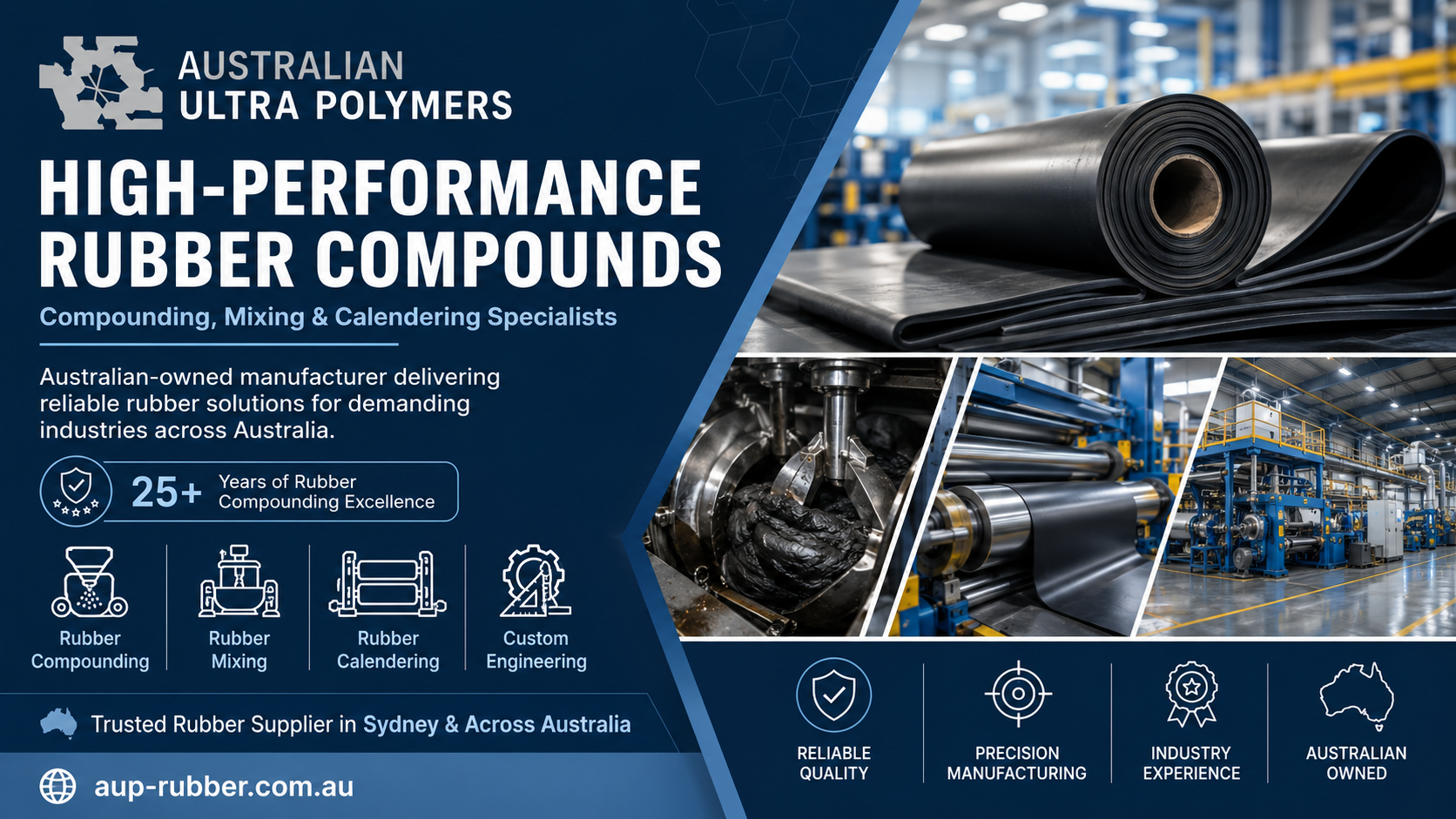
Rubber is one of the most versatile materials in industrial manufacturing. From seals and gaskets in heavy machinery to vibration mounts in conveyor systems, rollers in production lines, and protective components in mining equipment, the right rubber part keeps industrial operations running reliably.
The most common way to produce purpose-built rubber parts is through rubber moulding — a manufacturing process that shapes raw rubber into specific designs, sizes, and performance specifications. Combined with proper rubber compounding, it allows manufacturers to engineer parts that perform exactly as needed in real operating conditions.
For businesses that depend on durable industrial rubber components, understanding how moulding and compounding work helps you specify the right product, ask the right questions, and avoid the costly failures that come from using the wrong material in the wrong application.
What Is Rubber Moulding?
Rubber moulding is a manufacturing process where raw or compounded rubber is placed into a mould cavity, then cured under heat and pressure to take on its final shape. The vulcanisation process cross-links the polymer chains, giving the finished part its strength, elasticity, and durability.
Once cured, the part is removed from the mould, trimmed, and finished. The result is a custom-engineered component built for a specific application — not a generic off-the-shelf product.
Moulded rubber parts are used across mining, manufacturing, automotive, marine, construction, agriculture, food processing, and infrastructure industries.
Why Rubber Moulding Matters in Industry
Industrial environments place heavy demands on materials. Components may need to withstand pressure, vibration, chemicals, abrasion, UV exposure, extreme temperatures, or constant flexing.
Standard off-the-shelf rubber products often can't meet these demands. Moulding allows parts to be built to suit the application — the right shape, the right hardness, the right chemical resistance, and the right operating temperature range. This translates directly into improved reliability, longer service life, and lower total cost of ownership.
Common Rubber Moulding Methods
The best method depends on part design, material, production volume, and tolerance requirements.
1. Compression Moulding
Compression moulding is the most widely used method. A pre-measured rubber preform is placed into an open mould, which is then closed under pressure and heat to cure the material.
Best for low-to-medium volume runs and ideal for seals, pads, gaskets, bushings, and custom shapes. It's the most cost-effective method for moderate production because tooling is relatively simple.
2. Transfer Moulding
Transfer moulding uses a separate chamber to push rubber through runners into a closed mould cavity. This allows more precise filling, better dimensional control, and easier inclusion of metal inserts.
Best suited to parts with complex geometry, embedded fasteners, or tighter tolerance requirements than compression moulding allows.
3. Injection Moulding
Injection moulding forces heated rubber under high pressure into a closed mould. It produces highly consistent parts at high volume — making it the standard for automotive components, mass-produced seals, and any application needing thousands of identical parts.
Tooling cost is higher, but per-part cost drops significantly at volume.
What Is Rubber Compounding?
Rubber compounding is the process of blending raw rubber with selected additives — fillers, curing agents, accelerators, antioxidants, plasticisers, and pigments — to create a material with specific performance properties.
The base polymer alone rarely delivers everything an industrial application needs. Compounding lets manufacturers fine-tune hardness (typically Shore A 30 to 90), tensile strength, compression set, chemical resistance, temperature range, and abrasion resistance.
A well-engineered compound is the difference between a part that lasts 6 months and one that lasts 6 years.
Why Rubber Compounding Matters
Not all rubber is the same. A seal in a food processing plant needs different properties from a vibration mount in a mining truck or a roller in a paper mill.
Compounding allows manufacturers to engineer materials for specific applications: oil and fuel resistance for automotive seals, UV and ozone resistance for outdoor components, high-temperature stability for engine parts, or food-grade compliance for processing equipment.
Common Types of Industrial Rubber
Different polymers suit different jobs:
-
Natural rubber (NR) — Excellent tensile strength and elasticity. Operating range typically -50°C to +70°C. Suits dynamic applications needing strength and flex.
-
Neoprene (CR) — Good weather, ozone, and moderate oil resistance. -40°C to +100°C. Common for outdoor and general-purpose industrial use.
-
Nitrile (NBR) — Strong oil, fuel, and grease resistance. -30°C to +120°C. Standard for automotive seals, gaskets, and mechanical applications.
-
EPDM — Outstanding weather, UV, and ozone resistance. -40°C to +120°C. Used in roofing, water seals, and outdoor components.
-
Silicone (VMQ) — Wide temperature range, -60°C to +230°C. Used in food, medical, electrical, and high-temperature applications.
Material selection should always be based on actual operating conditions, not lowest cost.
Industrial Applications of Rubber Moulding
Moulded rubber components appear across nearly every heavy industry:
-
Seals, gaskets, and O-rings
-
Bushings and vibration mounts
-
Rollers, wheels, and pulleys
-
Conveyor system components
-
Mining equipment parts
-
Automotive engine and suspension components
-
Marine seals and fenders
-
Construction expansion joints
-
Custom protective covers
-
Food-grade processing seals
These products typically work where flexibility, sealing, cushioning, or impact resistance is essential.
Benefits of Rubber Moulding
-
Custom design — Parts made to exact shapes and dimensions, not adapted from stock items
-
Application-specific performance — Material and design engineered for actual operating conditions
-
Durability — With the right compound and process, parts perform reliably for years in demanding environments
-
Cost efficiency over lifecycle — Better seals and components reduce equipment wear, leakage, and downtime
-
Production consistency — Moulding produces parts with repeatable dimensions and performance
Factors to Consider Before Starting a Moulding Project
Before specifying a rubber component, gather:
-
Application purpose and function
-
Operating temperature range
-
Chemicals or fluids the part will contact
-
Load, pressure, and movement requirements
-
Abrasion or impact exposure
-
Required hardness (Shore A) and flexibility
-
Environmental conditions (UV, ozone, salt, etc.)
-
Production quantity required
-
Expected product lifespan
The more accurate the brief, the better the manufacturer can recommend material and method.
Why Quality Control Is Important
Industrial rubber parts often perform safety-critical roles. A failed seal can release hazardous fluid; a failed vibration mount can damage equipment worth thousands of times more than the rubber part itself.
Quality control covers dimensional checks, hardness testing, material verification, batch consistency, and finish inspection. Reputable manufacturers also provide certificates of compliance for regulated applications (food contact, drinking water, medical use).
Choosing the Right Rubber Manufacturer
A capable manufacturer offers more than production. They understand materials science, application engineering, mould design, and quality assurance.
When comparing suppliers, look for experience across multiple industries, in-house compounding capability, mould design and tooling support, quality control documentation, ability to handle both prototype and production runs, and clear technical communication.
The best supplier becomes a partner — helping you specify the right product, not just quoting on the one you asked for.
Why Choose AUP Rubber
AUP Rubber provides moulded rubber products and engineered solutions for industrial applications. With expertise across rubber moulding, rubber compounding, and industrial rubber manufacturing, the company supports businesses that need durable, application-specific components built to perform in real working conditions.
Whether you need custom moulded parts, specialised compounds, or industrial rubber products for demanding environments, AUP Rubber delivers solutions tailored to the operating requirements of each application.
Frequently Asked Questions
Which rubber moulding method is most cost-effective for low production volumes? Compression moulding is typically the most cost-effective for low-to-medium volume runs because tooling costs are lower than injection or transfer moulding.
What's the difference between rubber moulding and rubber extrusion?
Moulding produces discrete shaped parts cured inside a mould. Extrusion produces continuous lengths of profile (like seal strips or hose) by forcing rubber through a shaped die.
How is rubber hardness measured?
Industrial rubber hardness is measured on the Shore A scale, ranging from very soft (around 20 Shore A) to very hard (around 90 Shore A). Most industrial parts fall between 40 and 80 Shore A.
Which rubber type handles the highest temperatures?
Silicone rubber typically handles the highest continuous operating temperatures, performing well from around -60°C to +230°C. Specialised fluoroelastomers (FKM) can handle even higher.
Can rubber compounds be customised for specific applications?
Yes. Compounding allows manufacturers to engineer rubber for specific resistance properties (oil, chemicals, UV, abrasion) and physical characteristics (hardness, elasticity, tensile strength).
How long do moulded rubber parts typically last?
Lifespan depends entirely on the compound, application, and operating conditions. Well-specified industrial rubber parts can last 5 to 15 years or more in normal service.
Final Thoughts
Rubber moulding is essential to modern industry. Combined with proper rubber compounding, it produces strong, flexible, application-specific components that perform reliably in some of the toughest working environments.
For any business depending on industrial rubber components, the choice of material, method, and manufacturer directly affects equipment performance, maintenance costs, and operational reliability. Choose well, and the rubber parts you specify become long-term assets rather than recurring problems.

 Arabic
 French
 Spanish
 Portuguese
 Deutsch
 Turkish
 Dutch
Dutch
 Italiano
 Russian
 Romaian
 Portuguese (Brazil)
 Greek
Greek
