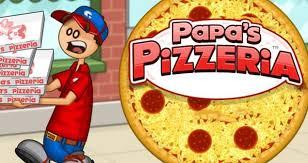
There’s a weird familiarity in Papa’s Pizzeria. Not because most people have worked in a pizzeria, but because the structure feels like work simplified down to its purest loop. You don’t wander, you don’t explore—you execute tasks in a steady chain: take order, build pizza, bake, slice, serve.
At first, it looks almost too basic to hold attention.
But after a few minutes, something changes. The simplicity stops feeling empty and starts feeling focused. You’re no longer thinking about “a game.” You’re thinking about tasks that need to be completed in sequence, with just enough pressure to keep your attention anchored.
It becomes less like play and more like a controlled workflow you don’t mind repeating.
The rhythm that replaces storytelling
There’s no narrative pulling you forward in a traditional sense. No dramatic arc. No unfolding mystery. Instead, the game replaces story with rhythm.
Every order follows the same structure, but the timing is never identical. One customer might give you breathing room. Another might arrive just as two pizzas are already in motion. Suddenly, your calm workflow turns into a juggling act.
That shift is subtle, but constant.
You start to feel the game in cycles: moments where everything is under control, followed by moments where everything is slightly behind. Neither state lasts long enough to settle into boredom or panic.
That balance is what keeps attention locked in place.
Why multitasking feels so natural here
The real hook isn’t cooking—it’s managing multiple incomplete tasks at once.
One pizza is in the oven. Another is halfway through toppings. A third is waiting for preparation. Each one exists in a different stage of completion, and your job is to keep all of them moving without letting any collapse.
It doesn’t feel like multitasking at first. It feels like reacting.
But over time, your brain starts building a map of priorities. You begin mentally ranking urgency without thinking about it. Oven timers become background awareness. Order complexity becomes a quick judgment. Topping work becomes something you learn to pace rather than rush.
The game quietly trains you to distribute attention instead of focusing it.
That’s where its hold comes from.
The satisfaction of controlled pressure
What makes Papa’s Pizzeria interesting is that it never removes pressure—it just keeps it manageable.
There is always something waiting. Always something slightly unfinished. But it never escalates into chaos that feels impossible to resolve.
That creates a specific emotional space: controlled pressure.
You’re always doing something, always catching up, but never fully overwhelmed. And that state is strangely satisfying. It feels active without being stressful in a negative way.
Mistakes don’t break the flow. They just adjust your next move.
Burn a pizza slightly? You adapt. Mess up topping placement? You slow down next time. Forget an order in the oven too long? You start tracking timing more carefully.
The loop absorbs error instead of punishing it harshly.
Customers as signals, not people
In Papa’s Pizzeria, customers are not really characters you get attached to. They function more like signals in a system.
One tells you to slow down. Another tells you to speed up. Another forces you to prioritize precision over speed.
Over time, you stop seeing them as individuals and start reading them as workload indicators. Their presence changes how you manage everything else in motion.
That shift is important. It turns the game into a kind of live balancing system where each new order slightly reshapes your internal priorities.
It’s not about personality—it’s about pressure distribution.
The oven as the hidden tension point
If there’s a mechanic that quietly defines everything, it’s baking.
The oven introduces delayed consequences. You don’t interact with it constantly, but you never stop thinking about it.
That creates a split attention state. One part of your mind focuses on immediate tasks, while another keeps track of what’s currently baking and how long it’s been there.
This dual awareness is what gives the game its steady tension.
Nothing is urgent in the moment—but something is always becoming urgent.
That difference matters. It keeps the experience from feeling static even when no visible action is happening.
Why repetition doesn’t turn into boredom
Repetition is usually where games lose momentum. But here, repetition is structured in a way that never fully repeats the same experience.
The system stays the same, but the combinations change.
Different orders, different timing overlaps, different customer sequences—all of these create small variations inside a fixed framework.
So instead of repetition feeling identical, it feels slightly reshuffled each time.
And because your skill is also evolving, each repetition is experienced differently on your side as well.
What once felt chaotic starts feeling manageable. What once required focus becomes automatic.
That personal shift keeps the loop from going stale.
The invisible progression of skill
One of the most interesting parts of the experience is how improvement sneaks up on you.
There’s no big moment where the game tells you that you’ve gotten better. No dramatic unlock. No sudden shift in difficulty curve.
Instead, you just notice things happening less often.
Fewer burnt pizzas. Faster transitions between stations. Less hesitation when multiple orders stack up.
At first, these changes feel accidental. Then they become consistent.
And eventually, the game feels like something you’ve internalized rather than something you’re actively learning.
That slow absorption of skill is part of what makes it memorable.
The calm inside constant activity
Despite the constant movement, the game rarely feels emotionally intense. It sits in a strange middle space where you are always doing something, but never overwhelmed.
That’s because the tasks are small and predictable. Nothing requires deep decision-making, but everything requires attention.
So your mind stays engaged without being overstimulated.
It’s a kind of low-grade focus that feels stable over long periods of time.
You don’t realize how long you’ve been playing because nothing ever forces you to stop and reset mentally.
A loop that quietly teaches prioritization
At its core, the game is less about pizza and more about managing attention under light pressure.
You learn to decide what matters first without being told explicitly. You learn to balance speed and accuracy. You learn to keep track of multiple moving elements without losing control of any single one.
And all of this happens through repetition, not instruction.
That’s why the loop sticks. It doesn’t just entertain—it trains a way of thinking that feels surprisingly natural once it clicks.



 Dutch
Dutch

 English
 Arabic
 French
 Spanish
 Portuguese
 Deutsch
 Turkish
 Italiano
 Russian
 Romaian
 Portuguese (Brazil)
 Greek
Greek