Aluminum has become a critical material in modern manufacturing due to its lightweight structure, corrosion resistance, and high strength-to-weight ratio. However, joining aluminum efficiently remains a technical challenge for many production environments. This is where an aluminum spot welder plays a vital role delivering fast, repeatable, and high-quality welds for industrial-scale aluminum assembly.
For OEMs, automotive manufacturers, appliance producers, and EV battery system integrators, selecting the right aluminum spot welding technology directly impacts production efficiency, joint reliability, and overall manufacturing cost.
What is an Aluminum Spot Welder?
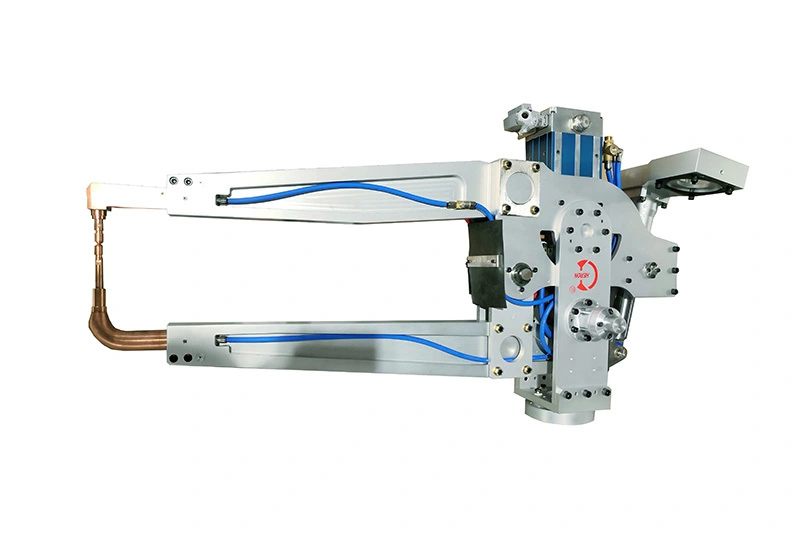
An aluminum spot welder is a specialized resistance welding machine designed to join aluminum sheets or components by applying controlled pressure and high electrical current at localized points.
Unlike traditional welding processes that rely on filler materials, spot welding creates a solid-state or fusion bond through:
Heat generated by electrical resistance
Electrode force applied to the workpiece
Precise current control and welding time
Aluminum presents unique challenges due to its high thermal conductivity and low electrical resistance, which require advanced control systems such as MFDC (Medium Frequency Direct Current) technology for stable and consistent weld formation.
Why Aluminum is Difficult to Spot Weld
Before understanding the machine, it is important to recognize the material challenges:
1. High Thermal Conductivity
Aluminum dissipates heat quickly, making it harder to maintain sufficient temperature at the weld nugget.
2. Oxide Layer Formation
A natural oxide layer forms instantly on aluminum, increasing electrical resistance inconsistency.
3. Low Electrical Resistance
This reduces heat generation at the contact point, requiring higher current levels.
4. Electrode Wear
Aluminum tends to stick to electrodes, leading to faster degradation and maintenance requirements.
Because of these factors, standard steel spot welding systems are not sufficient for aluminum applications. Advanced aluminum spot welders are engineered specifically to overcome these limitations.
How an Aluminum Spot Welder Works
Modern aluminum spot welders rely heavily on MFDC resistance welding technology combined with intelligent control systems.
Welding Process Steps:
Clamping Stage Electrodes apply pressure on aluminum sheets to ensure firm contact.
Current Application High-frequency DC current passes through the material, generating resistance heat.
Nugget Formation Heat melts the interface, forming a molten weld pool.
Solidification Pressure is maintained while the weld cools and solidifies.
Release Electrodes retract, completing the weld cycle.
Why MFDC Technology Matters
MFDC systems improve aluminum welding performance by:
Providing stable current output
Reducing energy consumption
Enhancing weld consistency
Allowing precise control over short weld cycles
This makes them ideal for high-volume manufacturing environments such as automotive body-in-white production lines.
Key Components of an Aluminum Spot Welding System
A high-performance aluminum spot welder typically includes:
1. Welding Power Supply (MFDC Inverter)
Converts AC power into controlled DC output for precise energy delivery.
2. Welding Controller
Manages parameters such as current, weld time, squeeze time, and force profiles.
3. Welding Guns or Electrodes
Designed with copper alloys optimized for aluminum resistance welding.
4. Cooling System
Water-cooled electrodes and cables prevent overheating during continuous operation.
5. Automation Interface
Enables integration with robotic arms and production lines for high-speed manufacturing.
Industrial Applications of Aluminum Spot Welders
Aluminum spot welding is widely used across industries requiring lightweight and durable structures:
Automotive Manufacturing
Body panels
Door assemblies
EV battery enclosures
Structural reinforcement components
Aerospace Industry
Lightweight fuselage components
Interior panel assemblies
Electrical & Electronics
Heat sinks
Enclosures
Conductive assemblies
HVAC and Appliance Manufacturing
Aluminum housings
Cooling system components
EV Battery Production
Cell-to-busbar connections
Module assembly structures
With increasing demand for electric vehicles and lightweight transport solutions, aluminum spot welding has become a core manufacturing process globally.
Aluminum Spot Welding vs Other Joining Methods
Understanding how aluminum spot welding compares with alternative technologies helps manufacturers choose the right process.
1. Spot Welding vs MIG Welding
Spot welding: Faster, automation-friendly, minimal filler material
MIG welding: More flexible but slower and requires skilled operators
2. Spot Welding vs TIG Welding
Spot welding: High-speed mass production
TIG welding: High precision but low productivity
3. Spot Welding vs Riveting/Mechanical Fastening
Spot welding: Permanent, lightweight joint
Riveting: Adds weight and increases assembly complexity
Adhesives: Require curing time and environmental sensitivity
For large-scale aluminum manufacturing, resistance spot welding remains one of the most efficient and cost-effective solutions.
Best Practices for High-Quality Aluminum Spot Welding
To achieve consistent weld quality, manufacturers should follow these best practices:
1. Optimize Welding Parameters
Fine-tune current, time, and electrode force based on aluminum grade and thickness.
2. Maintain Electrode Condition
Regular dressing and replacement ensure stable contact resistance.
3. Ensure Proper Surface Preparation
Remove contaminants and reduce oxide layer impact for better conductivity.
4. Use Advanced Cooling Systems
Prevent overheating during continuous production cycles.
5. Implement Real-Time Monitoring
Use digital controllers to track weld quality and detect anomalies early.
6. Select the Right Alloy Compatibility
Different aluminum alloys behave differently under resistance welding conditions.
Choosing the Right Aluminum Spot Welder
When selecting a machine for industrial production, consider:
Material thickness range
Production speed requirements
Automation compatibility
Energy efficiency
Control system precision
Electrode life and maintenance needs
For high-volume OEM manufacturing and automated production lines, MFDC-based systems with robotic integration are typically the most effective choice.
Heron Welder: Industrial Expertise in Aluminum Spot Welding Solutions
For manufacturers seeking reliable and high-performance aluminum welding systems, Heron Welder offers advanced resistance welding technologies designed for modern production demands.
With expertise in resistance spot welding, MFDC systems, automated welding lines, clinching, and self-piercing riveting technologies, Heron provides tailored solutions for industries such as automotive, EV manufacturing, HVAC, and metal fabrication.
Their engineering-driven approach focuses on:
High-efficiency welding performance
Automation-ready system integration
Consistent weld quality for aluminum applications
Industrial-grade durability for continuous production
FAQs About Aluminum Spot Welder
1. Can aluminum be spot welded effectively?
Yes, aluminum can be spot welded using specialized MFDC resistance welding systems designed to handle its high conductivity and oxide layer.
2. What type of spot welder is best for aluminum?
MFDC inverter-based spot welders are the most effective due to their stable current control and high precision.
3. Is aluminum spot welding stronger than riveting?
Yes, spot welding provides a permanent metallurgical bond that is typically stronger and lighter than mechanical fastening methods.
4. What industries use aluminum spot welders the most?
Automotive, EV battery manufacturing, aerospace, HVAC, and appliance industries are the primary users.
5. How can weld quality be improved in aluminum spot welding?
Conclusion: The Future of Aluminum Joining Technology
As industries continue to shift toward lightweight materials and energy-efficient manufacturing, aluminum spot welding is becoming increasingly essential. Its ability to deliver fast, reliable, and automation-friendly joints makes it a cornerstone technology for modern production systems.
For companies aiming to improve welding efficiency, reduce production costs, and scale automation, investing in advanced aluminum spot welding systems is no longer optional—it is a competitive necessity.
Looking to upgrade your aluminum welding process? Connect with Heron Welder for customized aluminum spot welding solutions tailored to your production needs and automation goals.



 Greek
Greek

 English
 Arabic
 French
 Spanish
 Portuguese
 Deutsch
 Turkish
 Dutch
Dutch
 Italiano
 Russian
 Romaian
 Portuguese (Brazil)