


Understanding CE Safety Ratings in Women's Textile Motorcycle Jackets
You're looking at two jackets. Both say "CE certified." Both look similar on the hanger. One costs significantly more than the other.
What's actually different?
If you don't understand CE safety ratings, you're essentially guessing at your own protection level. And when it comes to motorcycle gear, guessing isn't a strategy.
Women's textile motorcycle jackets have become incredibly sophisticated in how they integrate protection, but the labeling can be confusing, inconsistent, and sometimes deliberately vague. This guide cuts through that and tells you exactly what CE ratings mean, what to look for, and how to make sure the jacket you buy actually protects you the way it claims.
What CE Rating Actually Means
CE stands for Conformité Européenne, a European safety standard that's become the global benchmark for motorcycle protective gear.
When a jacket or its armor carries a CE mark, it means the product has been independently tested and meets minimum safety requirements for impact protection. It's not a marketing claim. It's a verified standard.
Why CE Ratings Matter for Women Riders
For a long time, women's motorcycle gear was either non-existent or just shrunken men's gear. Protection standards were an afterthought.
That's changed. Abrasion resistant women's textile motorcycle jackets now come with gender-specific cuts and CE-rated armor positioned correctly for women's anatomy, not just scaled down from men's patterns.
The CE rating gives you an objective measure of protection regardless of how good the jacket looks or how convincing the product description sounds.
The Standard Behind the Rating
The current standard governing motorcycle protective equipment is EN 17092. This replaced the older EN 13595 standard and introduced a clearer classification system for complete jackets, not just the armor inside them.
Understanding this standard is how you separate genuinely protective ladies textile motorcycle jackets from gear that just looks the part.
CE Levels Explained
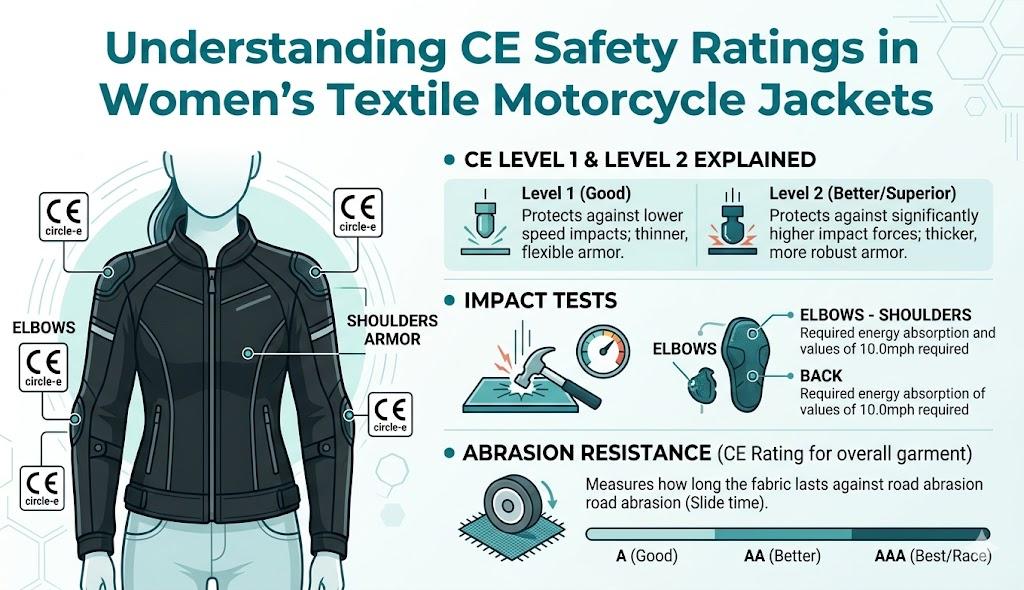
This is where most people get confused. There are two separate CE level systems to understand: one for the jacket itself and one for the armor inside it.
Jacket Classification Under EN 17092
Under the current standard, complete motorcycle jackets are rated on a scale:
-
AAA: Highest protection level. Tested for abrasion resistance, seam strength, and impact. These jackets can handle serious road contact and are built for high-speed riding and track use.
-
AA: Strong all-around protection. Suitable for most road riding scenarios including highway speeds. Good abrasion resistance and solid seam integrity.
-
A: Entry-level protection. Suitable for lower-speed urban riding. Less abrasion resistance than AA or AAA. Not ideal for highway or high-speed riding.
-
B: Protective properties but not tested for abrasion resistance in the same way. Usually applied to more casual or fashion-oriented riding gear.
For most women riders on public roads, AA is the minimum to aim for. AAA is worth the investment if you ride fast, ride frequently, or want maximum confidence.
Armor Ratings: Level 1 vs. Level 2
Inside the jacket, the armor at shoulders, elbows, and back has its own CE rating, separate from the jacket classification.
-
CE Level 1 Armor: Meets the baseline standard. Transmits a maximum of 18kN of force on impact. Adequate for casual riding and everyday commuting.
-
CE Level 2 Armor: Higher standard. Transmits a maximum of 9kN of force, absorbs significantly more impact energy. Recommended for highway riding, touring, and anyone who wants serious protection.
The difference isn't subtle. Level 2 armor absorbs roughly twice the impact energy compared to Level 1. In a real crash, that gap matters.
Where Armor Should Be in a Women's Jacket
A CE rating only means something if the armor is positioned correctly. This is where women's specific construction becomes critical.
Shoulder Armor
Should sit centered over your shoulder joint, not forward toward your collarbone or back toward your shoulder blade.
In riding position, your shoulder position shifts. A jacket designed for women accounts for this. Men's jackets sized down often don't, meaning shoulder armor ends up in the wrong place when you're actually on the bike.
Check: Sit in riding position and verify the armor sits directly over your shoulder joint, not sliding forward or backward.
Elbow Armor
Should cover your elbow joint completely when your arms are in riding position, reaching for handlebars.
This is one of the most common fit failures in women's textile motorcycle jackets. When you reach forward, sleeves ride up and elbow armor shifts toward your forearm. A properly fitted jacket keeps armor on your elbow, not two inches below it.
Check: Reach forward like you're gripping handlebars. Does elbow armor stay on your elbow?
Back Armor
Back protection is optional under some standards but strongly recommended.
A spine protector should run along your vertebrae from lower back to upper back. It should stay centered and not shift when you're seated and leaning forward.
Many ladies textile motorcycle jackets include a back armor pocket but ship without the armor itself, a cost-cutting measure. Always check whether back armor is included or if you need to purchase it separately.
Chest Armor
Not always included, but increasingly common in quality jackets.
Chest armor protects your sternum and ribs, areas that take impact in frontal collisions. If your jacket doesn't include chest armor, check whether it has chest armor pockets so you can add it.
How to Read CE Labels and Tags
Understanding the label on a jacket before you buy saves you from expensive mistakes.
What to Look For on the Jacket Tag
A legitimate CE-rated jacket should clearly show:
-
The EN standard number (EN 17092 for current standard)
-
The protection class (AAA, AA, A, or B)
-
Manufacturer information
-
The CE mark itself
If a jacket claims CE certification but doesn't list a specific standard, that's a red flag.
What to Look For on Armor Tags
Each piece of armor should have its own tag showing:
-
EN 1621-1 (limb armor, shoulders and elbows)
-
EN 1621-2 (back armor)
-
EN 1621-3 (chest armor, less common)
-
The CE level (1 or 2)
-
The size designation
If armor doesn't have individual tags, you can't verify its actual rating, regardless of what the jacket description says.
Beware of Vague Claims
Terms like "CE approved," "CE standard protection," or "CE quality" without specific standard numbers mean very little. They can be applied to anything.
Legitimate CE certification cites the exact standard and class. If a product description is vague about which standard applies, dig deeper before buying.
Textile vs. Leather for CE Ratings
A common misconception is that leather automatically offers better protection than textile.
The Reality
Under EN 17092, both leather and textile jackets are tested to the same standards and can achieve the same ratings. A textile jacket rated AA offers comparable protection to a leather jacket rated AA.
The material affects how the jacket achieves that rating, leather through natural abrasion resistance, textile through engineered fabric construction, but the outcome can be equivalent.
Why Textile Stands Out
What women's textile motorcycle jackets offer that leather doesn't is versatility in protection integration.
Textile construction allows for:
- Larger, more ergonomically shaped armor pockets
- Better armor retention systems that keep protection in place
- Removable armor for easy replacement or upgrading
- Integrated back protector channels designed for proper spine alignment
A well-designed textile jacket can position armor more precisely than leather, which matters more for women's specific fits.
Upgrading Armor in Your Jacket
Buying a jacket with Level 1 armor and upgrading to Level 2 later is a practical approach, especially if budget is a factor upfront.
Check Pocket Size First
Not all Level 2 armor fits in pockets designed for Level 1. Level 2 is typically thicker and sometimes larger.
Before buying separate armor, check the pocket dimensions against the armor you're considering. Some manufacturers sell matching upgrade armor for their specific jackets—that's the safest route.
Back Armor Upgrades
Back armor is the easiest to upgrade and often the most impactful.
If your jacket shipped without back armor, measure the back pocket dimensions carefully. A CE Level 2 back protector that fits properly is one of the best safety upgrades you can make.
Don't Mix Standards
Stick with armor that meets EN 1621 standards. Older armor might reference EN 13595 or have no standard listed, these don't guarantee current protection levels.
Replace old armor periodically. Impact-absorbing materials degrade over time, especially foam-based armor. If you've had the same armor for five or more years, it may no longer perform to its original rating.
Choosing the Right Protection Level for Your Riding
Urban and Commuter Riding
CE Class A jacket with Level 1 armor is a starting point, but Level 2 armor is worth the upgrade even for city riding. Urban environments mean frequent stops, unpredictable traffic, and lower speeds, but also more potential for intersection accidents.
Highway and Long-Distance Riding
CE Class AA minimum, Level 2 armor throughout. At highway speeds, impact forces are significantly higher. You want maximum absorption.
Touring and Adventure Riding
CE Class AA or AAA. Full armor set including chest and back. You're covering distance in varying conditions, protection should be comprehensive.
Occasional Weekend Riding
CE Class AA with Level 1 armor is reasonable. If budget allows, upgrade to Level 2 back armor at minimum, it's the most critical single piece of protection.
The Bottom Line on CE Ratings
CE ratings give you objective, verified information about protection, but only if you know how to read them.
For ladies textile motorcycle jackets, the key points are:
-
Aim for EN 17092 Class AA as your minimum standard
-
Level 2 armor is worth the cost difference over Level 1
-
Verify armor is positioned correctly for your body in riding position
-
Check individual armor tags, not just jacket marketing claims
-
Back armor matters, make sure it's included or add it yourself
Your jacket is the most important piece of gear you own. The CE rating system exists to help you make an informed decision. Use it.

 English
 Arabic
 French
 Spanish
 Portuguese
 Deutsch
 Turkish
 Dutch
Dutch
 Italiano
 Russian
 Romaian
 Greek
Greek
