


AI and Machine Learning in Fitness Apps: Real-World Use Cases
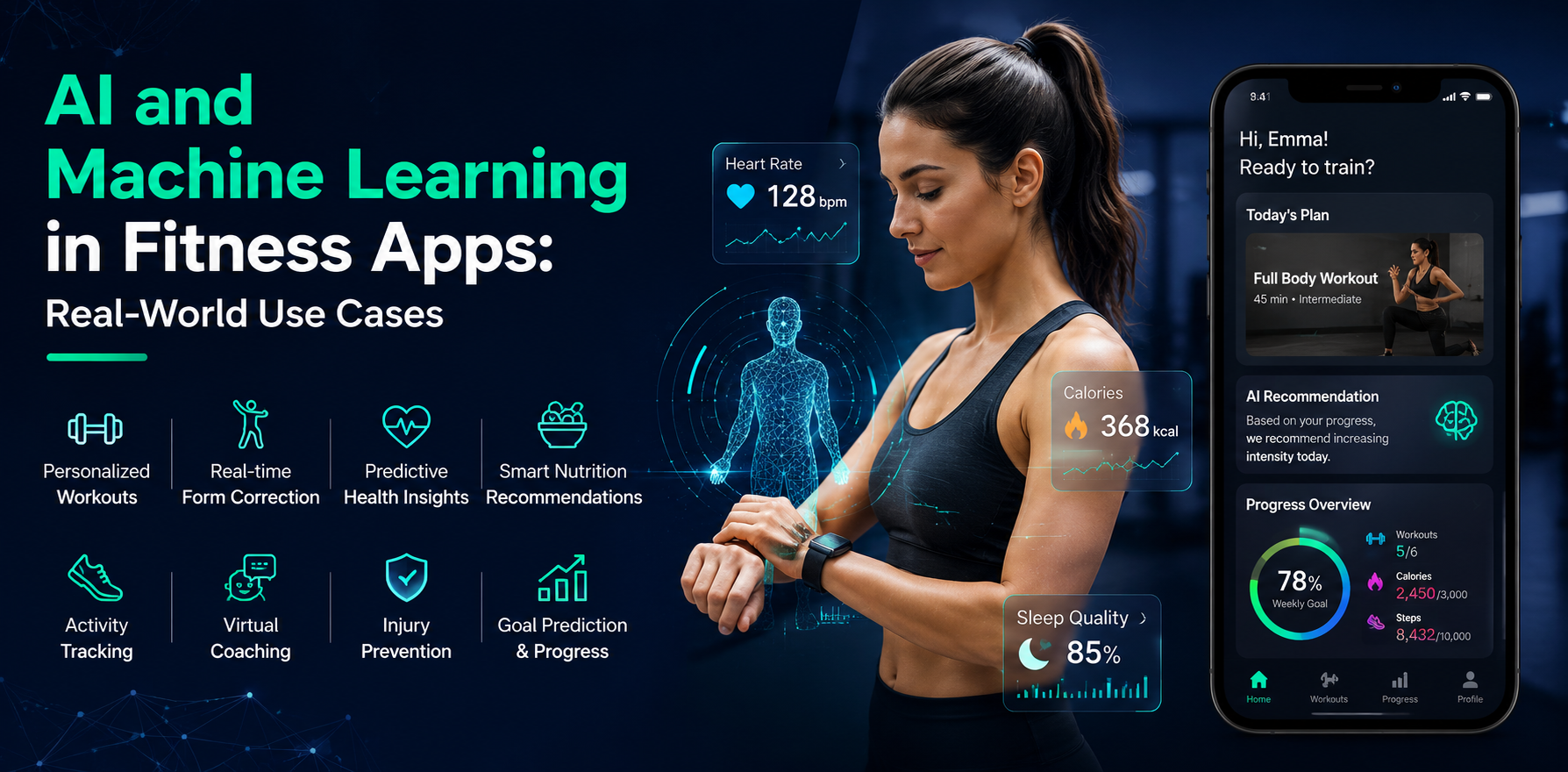
Artificial intelligence and machine learning are revolutionizing the digital health and wellness sector. Contemporary fitness applications go beyond mere activity trackers and calorie counters; they offer users personalized workout programs, real-time coaching, predictions of potential health concerns, and suggestions tailored to user behavior patterns. This technology has greatly enhanced user engagement as well as allowed individuals to be fitter and reach their goals faster.
With growing demand for innovative fitness solutions, corporations are increasingly adopting technologies that deliver highly personalized, data-driven experiences. This article is dedicated to examining how artificial intelligence and machine learning have revolutionized fitness applications through actual use cases.
What Are AI and Machine Learning in Fitness Apps?
AI assists applications in mimicking human intelligence via the processes of data analysis, pattern recognition, and decision-making. Machine learning (ML), which is a branch of AI, assists applications in improving their performance by learning from their previous experiences.
Combining both technologies makes fitness applications intelligent and personalized for the users.
Why AI Matters in Fitness Applications
Traditional fitness apps often offer static workout plans and basic activity tracking. AI-driven platforms, however, can analyze various factors such as:
-
Exercise history
-
Heart rate
-
Sleep patterns
-
Body measurements
-
Daily activity levels
-
Nutrition habits
-
Personal fitness goals
Based on this information, the app delivers customized recommendations that evolve as the user's progress changes.
Real-World Use Cases of AI and Machine Learning in Fitness Apps
1. Personalized Workout Recommendations
AI considers the fitness level, workout history, and performance of the user to provide personalized workout schedules. In lieu of giving the same workout schedule to all users, artificial intelligence suggests workouts according to their personal preferences, such as weight loss or gaining strength.
As users become stronger or more active, the recommendations automatically adjust to maintain progress.
2. Smart Virtual Personal Trainers
Modern fitness apps have the feature of AI-facilitated virtual personal coaches that assist in providing exercise instructions.
There are apps that have computer vision technology that help in detecting the body posture of the user and then provide recommendations for improving it.
3. Real-Time Form Correction
Posture recognition is one of the most exciting uses of AI technology. It employs a camera on your phone or another wearable device to determine how you move when doing squats, lunges, or push-ups.
The system identifies incorrect form and immediately suggests adjustments, helping reduce injury risks while improving workout efficiency.
4. Predictive Health Monitoring
Machine learning can identify trends in user health data collected over time. By analyzing heart rate, sleep quality, stress levels, and physical activity, AI may detect early signs of fatigue or overtraining.
This enables users to make informed decisions before small issues develop into larger health concerns.
5. Intelligent Nutrition Recommendations
Fitness goals depend heavily on proper nutrition. AI systems analyze dietary habits, calorie intake, allergies, and fitness objectives to recommend personalized meal plans.
Some apps also recognize food items through image recognition, simplifying calorie tracking and nutrition management.
6. Adaptive Fitness Plans
Unlike traditional programs that remain unchanged, AI continuously evaluates user progress.
If someone consistently completes workouts with ease, the application automatically increases exercise intensity. Conversely, if workouts become too challenging, AI modifies the routine to keep users motivated and prevent burnout.
7. Wearable Device Integration
Fitness apps increasingly integrate with smartwatches and fitness trackers. AI processes data collected from these devices, including:
-
Heart rate
-
Blood oxygen levels
-
Calories burned
-
Distance traveled
-
Sleep quality
-
Recovery metrics
The result is a more comprehensive understanding of a user's overall wellness.
8. AI Chatbots for User Support
AI-powered chatbots answer user questions instantly, provide workout suggestions, explain nutrition plans, and assist with technical issues.
This improves customer satisfaction while reducing the need for manual support teams.
9. Goal Prediction and Achievement Tracking
Machine Learning predicts whether users are likely to achieve their fitness goals based on historical performance.
If progress slows, the application recommends modifications such as increasing workout frequency, improving sleep habits, or adjusting calorie intake.
10. Injury Prevention
AI analyzes workout intensity, recovery time, and movement patterns to identify potential injury risks.
Instead of encouraging excessive training, the application may recommend rest days or lighter exercises when recovery appears insufficient.
Popular Fitness Apps Using AI
Several leading fitness platforms already leverage AI technologies, including:
-
Freeletics
-
Fitbod
-
MyFitnessPal
-
Nike Training Club
-
WHOOP
-
Strava
-
Centr
These applications demonstrate how AI can create highly personalized fitness experiences while improving long-term engagement.
Benefits of AI and Machine Learning in Fitness Apps
Businesses and users both benefit from AI-powered fitness solutions.
For Users
-
Personalized workout experiences
-
Better motivation and engagement
-
Accurate health insights
-
Faster goal achievement
-
Improved exercise safety
-
Smarter nutrition planning
For Businesses
-
Higher customer retention
-
Increased subscription revenue
-
Better user engagement
-
Valuable behavioral analytics
-
Competitive market differentiation
-
Improved customer satisfaction
Future Trends
The future of AI-powered fitness applications is expected to include:
-
Emotion-aware virtual fitness coaches
-
Digital twins for health prediction
-
AI-generated wellness programs
-
Advanced biometric analysis
-
Voice-controlled workout assistants
-
Augmented Reality fitness experiences
-
Hyper-personalized preventive healthcare recommendations
These innovations will further blur the line between personal trainers, healthcare professionals, and intelligent mobile applications.
Building an AI-Powered Fitness App
AI fitness app development entails skills in the field of AI, cloud technologies, wearable technology integration, and architecture. Hiring a reputable fitness app development company will allow companies to create secure, intuitive, and future-proof apps. From tailored training suggestions to advanced analytics and third-party integrations, a qualified development company will make it easy for companies to develop such an app.
Conclusion
In the world of modern fitness technology, artificial intelligence and machine learning play an important role. The use of AI in fitness applications is able to provide innovative features like customized training plans, nutrition recommendations, and many other elements that motivate people to exercise and take care of their health.
With each technological advancement, AI-based fitness apps will become increasingly intelligent, creating customized wellness paths. In turn, companies using such technologies can benefit greatly from it.

 Arabic
 French
 Spanish
 Portuguese
 Deutsch
 Turkish
 Dutch
Dutch
 Italiano
 Russian
 Romaian
 Portuguese (Brazil)
 Greek
Greek
