


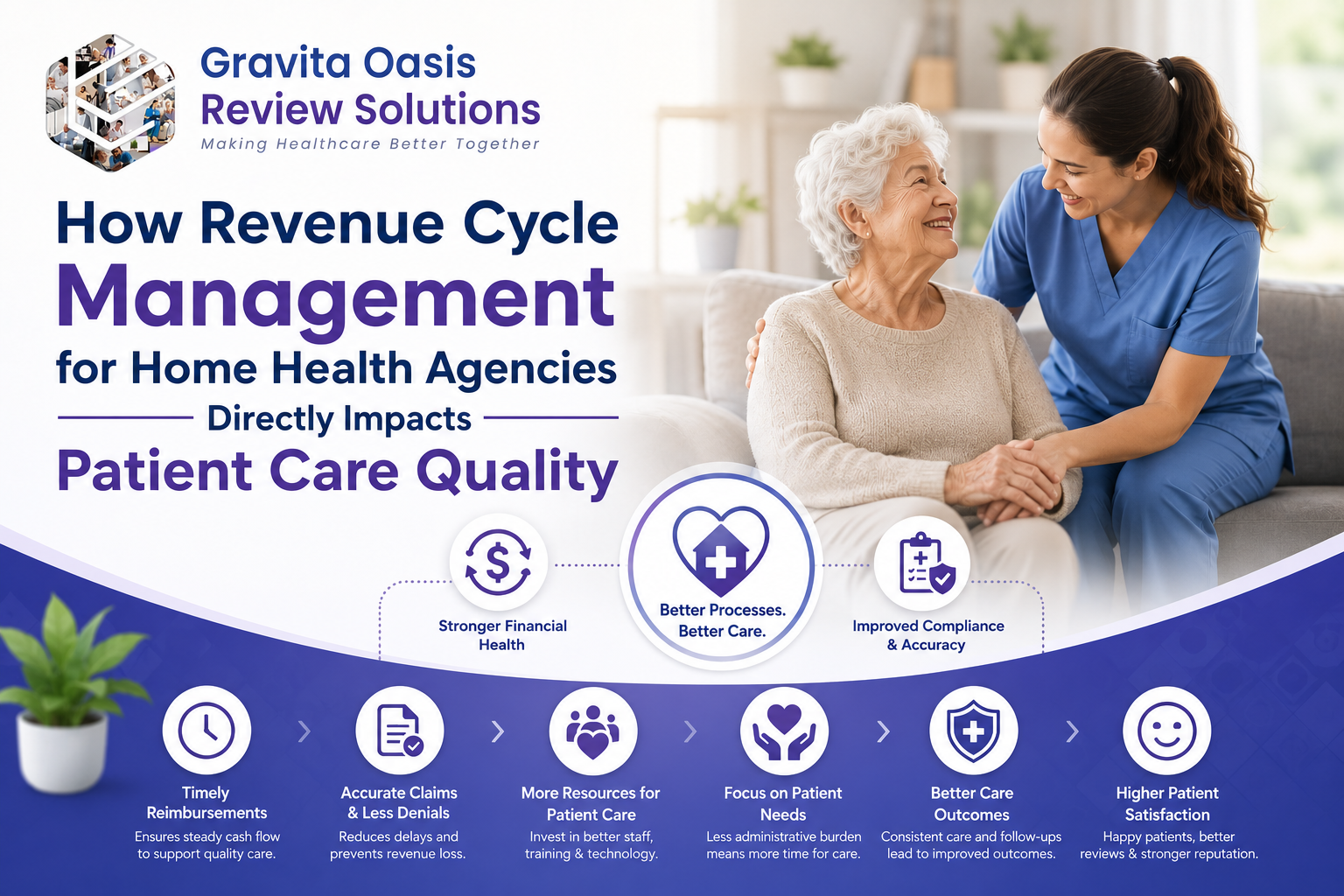
How Revenue Cycle Management for Home Health Agencies Directly Impacts Patient Care Quality
A home health nurse recently told me, "I spend almost as much time documenting visits as I do caring for patients." Unfortunately, many nurses and therapists across the country share that experience. Clinical teams often finish patient visits only to spend hours completing documentation, following up on missing physician signatures, checking authorization status, and answering billing-related questions.
Every minute spent on paperwork represents time away from patient care. While documentation and billing remain necessary, excessive administrative work can affect both staff satisfaction and patient outcomes. After working with home health agencies for many years, I have seen firsthand how financial processes influence the quality of care delivered in patients' homes.
The Hidden Connection Between Billing and Bedside Care
Many people view billing and patient care as separate functions. In reality, they remain closely connected.
A home health agency cannot provide high-quality care without financial stability. Agencies rely on timely reimbursement to hire qualified clinicians, invest in training, maintain appropriate staffing levels, and support clinical programs.
When reimbursement problems arise, agencies often experience staffing shortages, delayed hiring, and increased workloads for existing clinicians. Nurses and therapists may carry larger caseloads, which reduces the time available for each patient.
Administrative burden creates another challenge.
Clinical staff frequently assist with insurance verification, missing documentation, physician order corrections, and authorization follow-up. These responsibilities pull clinicians away from direct patient interaction.
Claim denials can also affect care delivery. When agencies struggle with collections, leadership may delay investments in education, technology, or additional support staff. Over time, these limitations can affect service quality and patient satisfaction.
Agencies that prioritize efficient home health billing processes often create stronger clinical environments because staff members can focus on what they do best—caring for patients.
Many organizations improve operational performance by partnering with Revenue Cycle Management for Home Health Agencies specialists who understand both reimbursement requirements and clinical workflows.
How Poor Documentation Affects Both Reimbursement and Patient Safety
Clinical documentation serves two equally important purposes. It supports reimbursement, and it communicates essential patient information to the entire care team.
Incomplete or inaccurate records create significant risks.
From a financial perspective, documentation deficiencies often lead to claim denials, payment delays, and compliance concerns. Missing physician signatures, unsupported diagnoses, or inconsistent visit notes frequently trigger payer scrutiny.
From a clinical perspective, poor documentation can affect patient safety.
Consider a patient recently discharged from the hospital after treatment for heart failure. If visit notes fail to document weight changes, medication adjustments, or worsening symptoms clearly, the next clinician may miss important warning signs. Delayed intervention can lead to avoidable hospital readmissions.
OASIS review plays a critical role here. Accurate assessments help agencies develop appropriate care plans, establish realistic goals, and capture patient needs correctly. Errors within OASIS assessments may affect both reimbursement and care planning.
Documentation inconsistencies also create confusion among physicians, therapists, nurses, and office staff. Clear communication remains essential when multiple clinicians participate in patient care.
Strong documentation practices protect patients while supporting financial performance.
What Happens When RCM Is Handled by Specialists
Specialized revenue cycle teams can significantly reduce administrative pressure on clinical staff.
First, clinicians spend less time addressing billing-related issues. Dedicated specialists manage insurance verification, claim follow-up, denial resolution, and payer communication. Nurses and therapists regain valuable time for patient visits and care coordination.
Second, prior authorizations move more efficiently.
Authorization delays often postpone services, disrupt care plans, and frustrate patients. Experienced teams monitor payer requirements closely, submit required documentation promptly, and track approval timelines carefully. Faster authorizations help patients receive needed care without unnecessary delays.
Third, specialized support improves OASIS accuracy.
Experienced reviewers identify inconsistencies, missing documentation, and assessment errors before submission. Better OASIS accuracy supports appropriate reimbursement while strengthening care planning and quality reporting.
Specialized teams also help reduce claim denials. Fewer denials mean fewer interruptions, less rework, and more predictable cash flow.
Perhaps most importantly, clinicians experience less stress. Reduced administrative burden allows staff members to focus more fully on patient interactions, education, and care coordination.
Gravita's Approach — Letting Clinicians Focus on Patients
At Gravita Oasis Review, the goal extends beyond processing claims.
The team understands that financial performance and patient care influence one another every day. By supporting agencies with OASIS review, ICD-10-CM coding, clinical documentation review, prior authorizations, medical billing, denial management, and EMR support, Gravita helps reduce unnecessary administrative work for clinicians.
Accurate coding and documentation reviews improve reimbursement while supporting compliance. Efficient authorization management helps prevent delays in patient care. Denial management specialists address reimbursement issues before they become major financial concerns.
EMR support also helps agencies improve workflows and reduce documentation challenges that often frustrate clinicians.
When agencies receive dependable operational support, nurses and therapists spend more time at the bedside and less time resolving administrative problems.
Many agencies choose Revenue Cycle Management for Home Health Agencies support because it allows their clinical teams to focus on delivering compassionate, high-quality care.
Closing Thoughts
Exceptional patient care depends on more than clinical expertise. Agencies also need strong financial processes, accurate documentation, efficient authorizations, and reliable reimbursement systems.
When administrative tasks overwhelm clinical teams, patient care may suffer. Investing in experienced revenue cycle support can reduce staff burden, improve documentation quality, and strengthen both financial and clinical outcomes.
If your agency wants to reduce administrative strain and give clinicians more time with patients, connect with Gravita Oasis Review through their contact page: https://www.gravitaoasisreview.com/contact.
Frequently Asked Questions
Q1: How does billing accuracy affect home health patient outcomes?
Accurate billing supports stable cash flow, which allows agencies to maintain staffing, invest in training, and provide consistent patient services. Documentation accuracy also helps ensure appropriate care planning.
Q2: Why do home health nurses spend so much time on documentation?
Home health nurses document assessments, physician orders, medications, care plans, and visit details to meet clinical and regulatory requirements. Many nurses also handle administrative tasks related to reimbursement and compliance.
Q3: Can outsourcing RCM reduce clinical staff burnout?
Yes. Outsourcing revenue cycle functions reduces administrative burden on clinicians by shifting billing, denial management, and authorization responsibilities to specialized teams.
Q4: What is the connection between OASIS accuracy and quality of care?
Accurate OASIS assessments help agencies develop appropriate care plans, identify patient needs, and establish realistic treatment goals. Errors can affect both reimbursement and clinical decision-making.
Q5: How do prior authorization delays affect home health patients?
Authorization delays may postpone treatment, disrupt continuity of care, and increase patient frustration. Timely approvals help ensure patients receive necessary services without interruption.

 English
 Arabic
 French
 Spanish
 Portuguese
 Deutsch
 Turkish
 Dutch
Dutch
 Italiano
 Russian
 Portuguese (Brazil)
 Greek
Greek
