


The Hidden Role of Agriculture Irrigation Pipes in Building Water-Efficient Farms
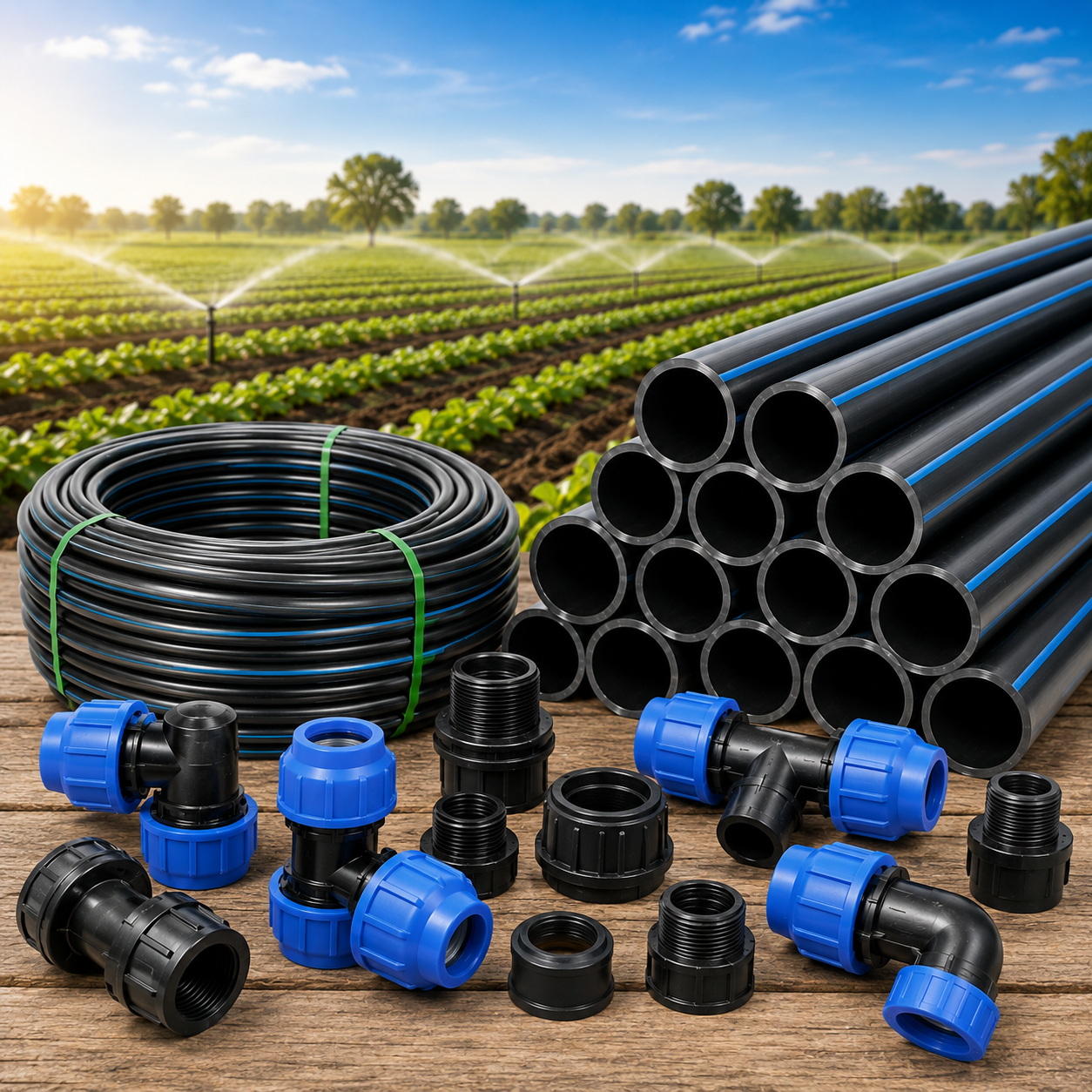
That’s where many buyers think water efficiency begins, but Agriculture Irrigation Pipes often decide how much water actually reaches the field. India’s annual groundwater extraction was assessed at 239.16 BCM, and 208.49 BCM—about 87%—was used for agriculture activities.
Which means pipe selection is not a side purchase. It is a water-management decision.
A weak pipe or mismatched fitting may not fail on day one. It usually starts with minor seepage, pressure drop, loose joints, or repeated field repair. Most buyers notice it only after labour has already been paid, the trench has been closed, and the farmer starts blaming the supplier.
Agriculture Irrigation Pipes: The Spec Details That Decide Water Loss
Wall Thickness Is Not Just a Rate Difference
The first specification to check is size compatibility. Pipe diameter, wall thickness, pressure requirement, socket depth, fitting grip, and length tolerance must match the irrigation layout.
Nobody tells you this early enough: a fitting that is “almost matching” can still become a leak point.
Agricultural Irrigation Pipe Fittings need the same scrutiny as pipes. Elbows, tees, reducers, bends, couplers, and end caps face pressure changes at turns and joints. If the pipe is approved but the fitting is from a loose batch, the field still suffers.
Flowtekpipes’ indexed site details mention checks such as pressure resistance, impact strength, temperature tolerance, dimensional accuracy, and leakage performance. These are the kind of QC points buyers should ask about before issuing a purchase order.
The Overlooked Spec: Pipe-Fitting Fitment
Most procurement teams compare pipe rate per piece. That is incomplete.
The better question is: has the supplier checked pipe and fitting fitment from the same production batch? A pipe may be acceptable alone, and a fitting may be acceptable alone, but the joint can still be weak if tolerances do not sit together properly.
That small mismatch becomes expensive in irrigation work.
Five Supplier Answers That Should Decide the Purchase
-
Specification confirmation — Ask for pipe size, pressure suitability, wall thickness, and fitting compatibility in writing. A bad answer sounds like, “standard agriculture size hai.”
-
Sampling approval — Before bulk dispatch, ask whether the sample represents the production batch. Sampling that is not linked to the actual batch is only theatre.
-
Certificate validity — Flowtekpipes’ indexed certificate page mentions ISO 9001:2015 certification with validity from January 2024 to January 2027. Buyers should still request the current certificate copy before final approval.
-
Lead time clarity — A weak supplier says, “dispatch ho jayega.” A better supplier gives stock status, production dependency, packing time, and transport pickup schedule.
-
Complaint policy — A supplier who says “we will see after complaint” does not have a policy. That is a negotiation you will lose after material reaches the site.
Benefits That Show Up After One Cropping Season
Good Agriculture Irrigation Pipes protect water first. Better joints reduce leakage points, and steady flow makes irrigation more predictable across the field.
They also protect pump performance. If pressure loss keeps happening through loose joints, the operator increases running time. That means more energy cost, more labour time, and more stress on the system.
Here’s the margin angle. Pipe failure does not only mean replacement cost. It means return freight, site arguments, unpaid invoices, and sometimes a damaged buyer relationship.
For wholesalers and procurement managers, consistent pipe and fitting batches reduce repeat complaints. One complaint from a farmer can travel faster than one good delivery.
Agriculture Irrigation Pipes also fit into India’s broader push for water-use efficiency. Under Per Drop More Crop, the Government of India reported 110.92 lakh hectares brought under micro-irrigation, accounting for about 7.98% of India’s net sown area.
And yet, pipes still get purchased like commodity items. That is the mistake.
Why Kundli–Sonipat Matters More Than a Map Pin
For buyers searching Agriculture Irrigation Pipes Manufacturers in India, location affects freight planning, replacement speed, and dispatch coordination.
Flowtekpipes is based in Kundli, Sonipat, Haryana - 131028, as per your brief and indexed website details. For North Indian buyers, this location can support practical coordination for Delhi-NCR, Haryana, Western UP, Rajasthan, and nearby procurement routes, depending on order size and transporter availability.
Local water conditions also matter. Recent reporting from Haryana noted that only 31.83% of groundwater was classified as good quality for high-quality irrigation, with other categories including saline, sodic, and marginally saline water.
Which means pipe buyers should not treat irrigation material as a simple stock item. Soil, water quality, crop type, and fitting layout affect field performance.
If you are comparing Agriculture Irrigation Pipes Suppliers in India or an Agriculture Irrigation Pipes Dealer in India, ask how they handle urgent replacements, mixed fitting orders, and transport damage claims.
What We Check Before Dispatch
We work from Kundli, Sonipat, Haryana, and our focus is on practical piping needs across categories such as CPVC, UPVC, AGRI, and SWR pipes and fittings, as reflected in Flowtekpipes’ indexed website information.
We know one operational truth from supply work: one missing fitting box can stop an entire irrigation installation.
That is why we treat Agriculture Irrigation Pipes and Agricultural Irrigation Pipe Fittings as one connected order, not two separate line items. Our dispatch thinking includes size matching, fitting counts, packaging condition, and whether the buyer has shared the final field requirement clearly enough before billing.
We do not believe a purchase order should depend on guesswork.
Send the Specs Before Asking the Rate
Send us the pipe size, required quantity, fitting list, delivery location, expected lead time, and MOQ expectation.
If sampling approval is needed, mention it before the purchase order. If certificate copy is needed for your file, ask before dispatch planning. If your project needs a faster response time, send the full requirement in one message instead of sending only “rate batao.”
We can reply better when we know what you are actually installing.
The Farm Loses Water Where Procurement Gets Casual
Agriculture Irrigation Pipes do more than carry water. They decide how much water stays useful after pressure, joints, field handling, and installation realities come into play.
For buyers, the better purchase is not always the cheapest pipe. It is the order where specifications, fittings, MOQ, lead time, and dispatch details are clear before material leaves the supplier.
Water-efficient farms will depend more on disciplined procurement, not just better farming advice.
FAQs
1.What are Agriculture Irrigation Pipes?
Agriculture Irrigation Pipes are the services used to deliver water from the supply channel into the field by means of controlled pathways. It is used in farm irrigation systems layouts, water transport system, pipe systems linked with joints, pumps or micro/mini-irrigation system.
2. Why are Agricultural Irrigation Pipe Fittings so important?
Leaking many times occurs at the joints. Agricultural Irrigation Pipe Fittings must fit the pipe size and pressure requirement accurately. The problem is straightforward: even well manufactured pipe may not deliver if fittings come from an inaccurate/separated batch.
3. How should I compare Agriculture Irrigation Pipes Manufacturers?
Please ask for specification details, QC checks, certificate copies, sample approvals, MOQ, lead time, wait time and general terms of the complaint procedure. Do not deal with a producer who can not or will not give written specifications as a safe long term supplier
4. Can Agriculture Irrigation Pipes Suppliers handle mixed fitting orders?
Some can, but mixed orders can require more clarity in counting and packing. The drawback is the very tiny amount of each fitting may impact the MOQ (minimum order quantity), dispatch, speed or packing accuracy. Please clarify before you are billed.
5. What should I ask an Agriculture Irrigation Pipes Dealer before placing an order?
Inquire about available stock, fitting compatability, transport packing, replacement conditions, whether the dealer can provide repeat supply. A dealer quoting only on the lowest rate may offer no assistance when site complaints begin to roll in.
6. Are Agriculture Irrigation Pipes Manufacturers in India suitable for bulk procurement?
Yes, most buyers who require bulk farm, dealer, wholesale, Agriculture Irrigation Pipes Suppliers from India do not address us. However, suitability much depend upon the adherence to the specifications, validity of certificates, consistency of batches, co-operating capacity of suppliers to schedule dispatches.
7. How do I find Agriculture Irrigation Pipes Suppliers or Agriculture Irrigation Pipes Dealer in India?
Selects on level on these factors of written specifications, practical lead time, flexibility with MOQ, availability of fitting and availability of replacement. Cost is important, but poor packing or unclear dispatch planning can wipe out the saving in one delayed shipment.
 Dutch
Dutch
 English
 Arabic
 French
 Spanish
 Portuguese
 Deutsch
 Turkish
 Italiano
 Russian
 Romaian
 Portuguese (Brazil)
 Greek
Greek
