


How Multi-Asset Tokenization Unlocks Diversified Investment Opportunities
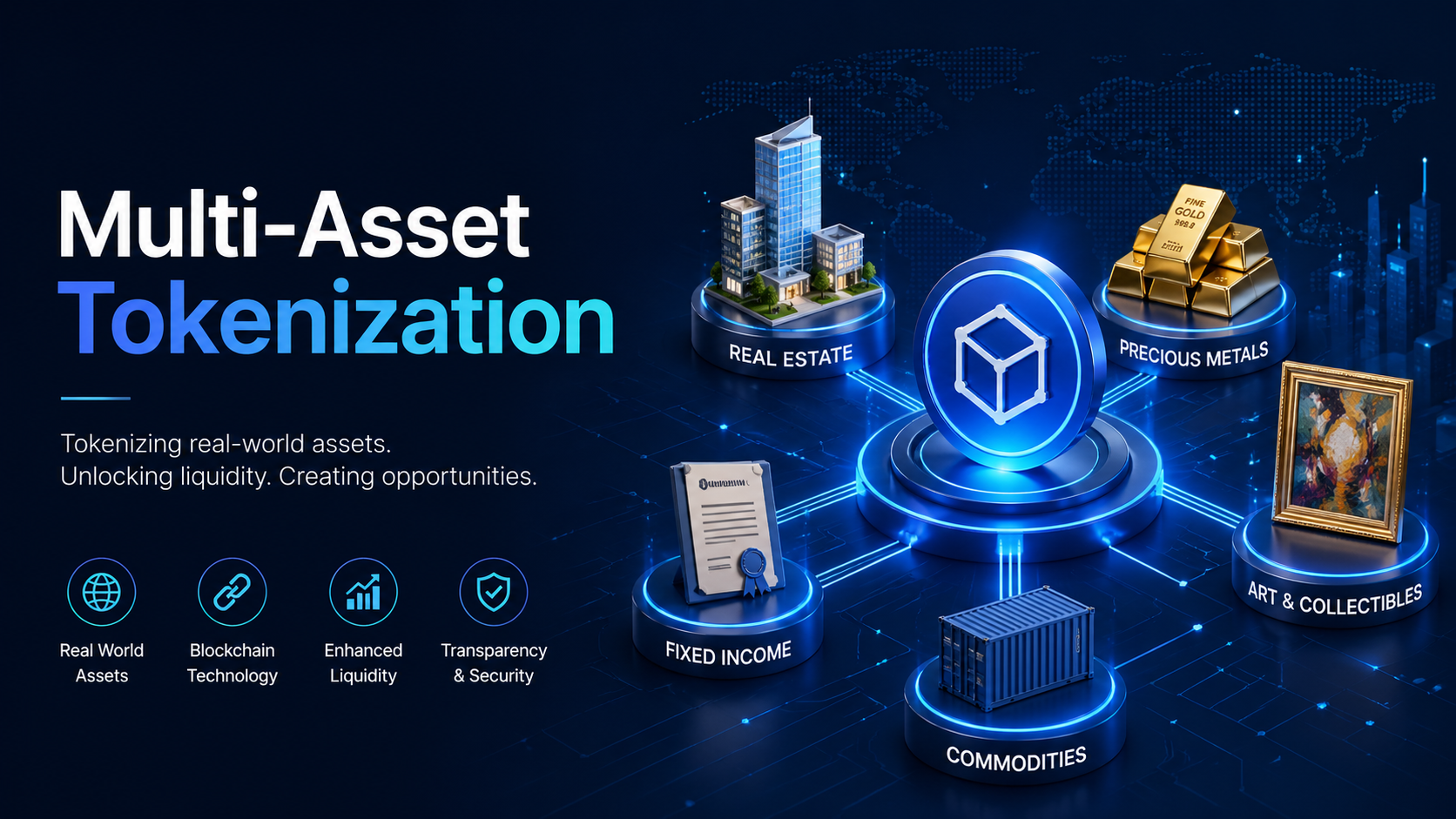
The evolution of blockchain-based finance is no longer limited to single-asset tokenization. A more advanced model is emerging multi-asset tokenization where different classes of real-world and financial assets are digitized and integrated into unified investment ecosystems. This approach allows investors to access, manage, and diversify across multiple asset categories through a single digital framework.
Instead of investing in isolated assets such as a single property or commodity, multi-asset tokenization enables exposure to a combination of assets including real estate, commodities, equities, debt instruments, infrastructure, and even intellectual property. This structural shift is transforming how portfolios are built, optimized, and managed in a digitally interconnected financial environment.
Understanding Multi-Asset Tokenization
Multi-asset tokenization refers to the process of converting multiple types of assets into blockchain-based tokens that can be issued, managed, and traded within a shared infrastructure. Each token represents ownership, rights, or economic exposure to a specific asset, but the key difference lies in aggregation—multiple asset types are accessible within the same ecosystem.
For example, a single platform may offer:
- Tokenized real estate units
- Commodity-backed tokens (gold, oil, agricultural products)
- Tokenized bonds or debt instruments
- Equity-like digital securities
- Infrastructure or revenue-generating assets
These assets can either be held individually or structured into diversified tokenized portfolios, funds, or baskets.
Why Diversification Matters in Modern Investment Strategy
Diversification has long been a core principle of investment management. By allocating capital across different asset classes, investors reduce exposure to the risks associated with any single asset or market.
Traditional diversification, however, comes with limitations:
- High capital requirements for accessing multiple asset classes
- Geographic and regulatory barriers
- Operational complexity in managing different investment vehicles
- Limited liquidity in certain asset categories
Multi-asset tokenization addresses these constraints by simplifying access and enabling fractional participation across a wide range of assets.
Key Ways Multi-Asset Tokenization Enables Diversification
1. Fractional Access Across Multiple Asset Classes
One of the most immediate benefits of multi-asset tokenization is the ability to invest in different asset classes with relatively small capital allocations.
Instead of committing large sums to individual investments, investors can distribute capital across:
- Multiple real estate properties
- Commodity-backed tokens
- Tokenized debt instruments
- Infrastructure projects
This fractional model enables broader diversification even for smaller portfolios, aligning real estate and alternative assets with the accessibility traditionally associated with equities.
2. Unified Investment Platforms
Multi-asset tokenization platforms consolidate different asset types into a single digital interface. This reduces the need for managing multiple accounts, intermediaries, and investment structures.
Within a unified platform, investors can:
- View and manage diversified portfolios
- Allocate capital across asset classes in real time
- Track performance across multiple sectors
- Execute transactions more efficiently
This integrated environment simplifies portfolio management and enhances decision-making.
3. Improved Portfolio Liquidity
Liquidity varies significantly across asset classes. While equities are highly liquid, real estate and infrastructure investments are traditionally illiquid.
Tokenization introduces the potential for secondary market trading across multiple asset categories, improving liquidity at the portfolio level. Even if individual assets have limited trading activity, a diversified tokenized portfolio can offer greater flexibility in managing liquidity. This enables investors to rebalance portfolios more dynamically than in traditional systems.
4. Cross-Asset Risk Distribution
Different asset classes respond differently to economic conditions. For example:
- Real estate may provide stable income during moderate inflation
- Commodities may perform well during supply shocks
- Fixed-income assets may offer stability during market downturns
Multi-asset tokenization allows investors to distribute risk across these varying performance patterns, reducing overall portfolio volatility. By integrating multiple asset types into a single framework, investors can achieve more balanced exposure to global economic trends.
5. Global Investment Exposure
Tokenization removes many geographic barriers associated with traditional investing. Investors can access assets located in different countries without the need for complex cross-border legal structures.
This enables exposure to:
- International real estate markets
- Global commodity supply chains
- Emerging market infrastructure projects
- Cross-border debt instruments
Global diversification enhances portfolio resilience and opens access to growth opportunities in different regions.
6. Programmable Portfolio Management
Smart contracts introduce programmability into portfolio management. This allows predefined investment rules to be executed automatically.
Examples include:
- Automated portfolio rebalancing based on asset allocation targets
- Scheduled income distribution from multiple assets
- Conditional investment triggers based on market conditions
Programmability reduces manual intervention and enhances efficiency in managing diversified portfolios.
7. Integration with Digital Financial Ecosystems
Multi-asset tokenization is not limited to static ownership. It can integrate with broader digital finance systems, enabling additional functionality such as:
- Using tokenized assets as collateral for loans
- Participating in yield-generating financial structures
- Accessing decentralized finance (DeFi) services
This integration expands the utility of diversified portfolios beyond passive investment.
Use Cases of Multi-Asset Tokenization
1. Tokenized Investment Funds
Asset managers can create tokenized funds that include a mix of real estate, commodities, and financial instruments. Investors gain exposure to diversified portfolios through a single tokenized product.
2. Hybrid Real Estate and Infrastructure Portfolios
Investors can combine property investments with infrastructure assets such as renewable energy projects or logistics networks, creating balanced income-generating portfolios.
3. Supply Chain and Commodity Integration
Tokenized supply chain assets can be combined with commodity tokens, enabling exposure to both production and distribution stages of economic activity.
4. Digital Wealth Management Platforms
Wealth management systems can use tokenization to offer diversified investment portfolios tailored to different risk profiles, with automated allocation and performance tracking.
Challenges Affecting Multi-Asset Tokenization
Despite its advantages, multi-asset tokenization faces several challenges:
Regulatory Complexity
Different asset classes are governed by different regulations, making unified tokenization frameworks difficult to implement.
Valuation Differences
Each asset class has unique valuation models, complicating portfolio pricing and performance tracking.
Liquidity Variability
Liquidity levels vary across assets, affecting overall portfolio flexibility.
Infrastructure Development
The ecosystem is still evolving, with limited interoperability between platforms.
Investor Understanding
Multi-asset tokenization introduces complexity that requires greater investor education and awareness.
Future Impact on Investment Markets
The long-term impact of multi-asset tokenization is expected to reshape how portfolios are constructed and managed.
Shift Toward Digitally Native Portfolios
Investment portfolios may increasingly exist in fully digital environments, with tokenized assets forming the core structure.
Increased Retail Participation
Lower entry barriers will enable broader participation in diversified investment strategies.
Convergence of Traditional and Digital Finance
Tokenization will bridge the gap between conventional financial systems and blockchain-based infrastructure.
More Dynamic Capital Allocation
Real-time data and automated systems will enable faster and more efficient allocation of capital across asset classes.
Conclusion
Multi-asset tokenization represents a significant evolution in investment strategy by enabling diversified exposure across multiple asset classes within a unified digital framework. By combining fractional ownership, improved accessibility, and programmable financial infrastructure, it removes many of the traditional barriers associated with diversification. While challenges related to regulation, valuation, and infrastructure remain, the model introduces a more flexible and globally connected approach to investing. As adoption grows, multi-asset tokenization is likely to play a central role in shaping the next generation of portfolio management and capital markets.

 English
 Arabic
 French
 Spanish
 Portuguese
 Deutsch
 Turkish
 Dutch
Dutch
 Italiano
 Romaian
 Portuguese (Brazil)
 Greek
Greek
