


How Company Registration Helps Startups Raise Funding
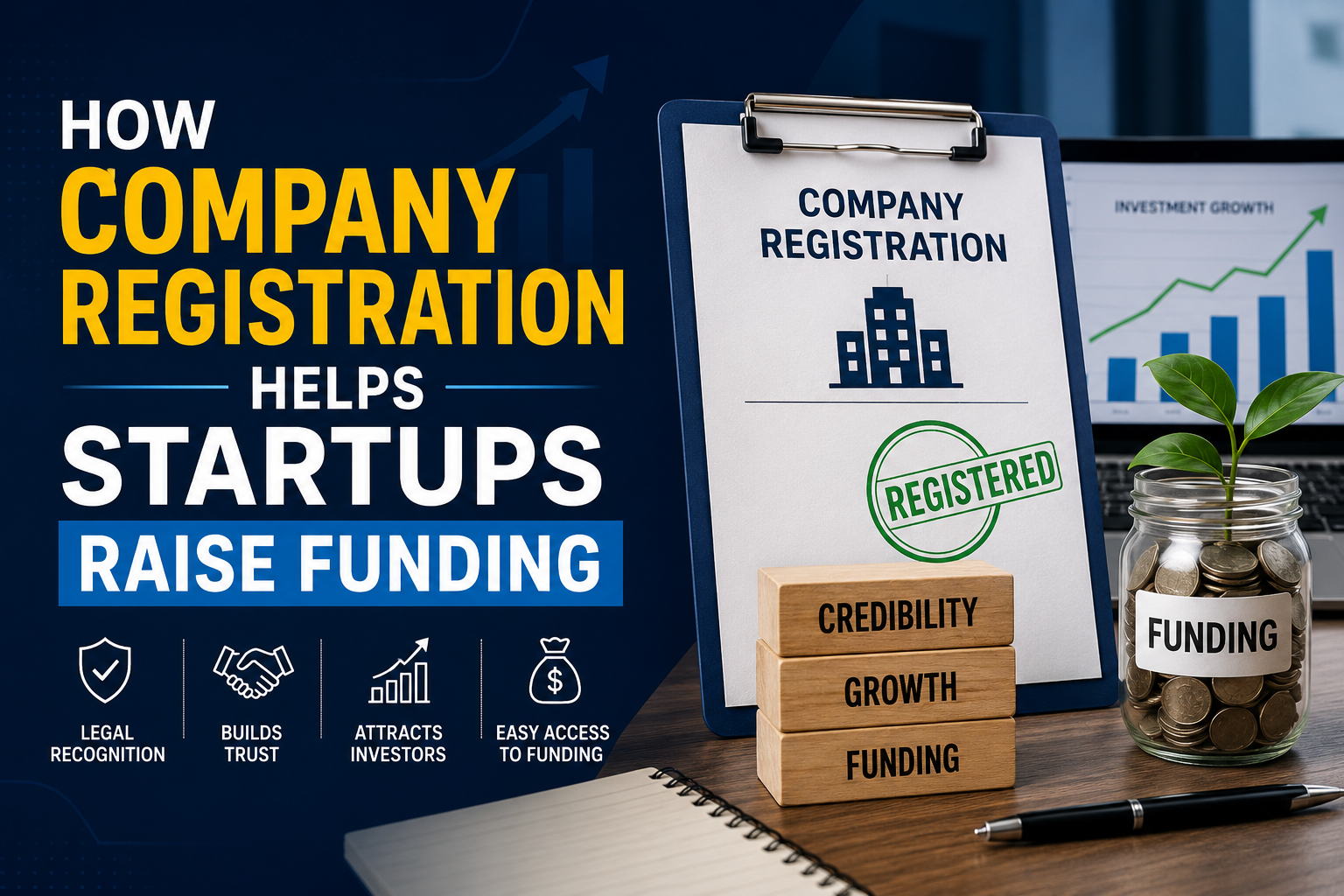
Launching a startup is exciting, but turning an idea into a fundable, investable business requires more than a great pitch deck. One of the most foundational steps every founder must take is registering their company. Yet many early-stage entrepreneurs skip or delay this step, unknowingly putting their funding prospects at serious risk.
If you're asking, "Do I really need to register my company before approaching investors?" the short answer is yes, almost always. Here's why the company registration process is not just a legal formality but a strategic funding enabler.
Why Investors Care About Legal Structure First
Before a venture capitalist, angel investor, or even a government grant body writes a single cheque, they perform due diligence. One of the very first things they check is whether your business is a legally recognised entity.
An unregistered startup is, in the eyes of the law, just a group of individuals. That means:
-
There is no entity to invest into
-
Equity cannot be formally issued or tracked
-
Investment agreements have no legal standing
-
Intellectual property belongs to individuals, not the company
A registered company, on the other hand, is a separate legal person. It can own assets, enter contracts, take on liabilities, and, crucially, issue shares. That's the foundation investors need before they'll even read your business plan.
The Funding Advantages of a Registered Company
1. You Can Issue Equity Legally
Equity is the currency of startup fundraising. Without company registration, there's no formal share structure, no cap table, and no mechanism to give investors an ownership stake. Registration creates the legal framework for all of this.
In India, for example, a Private Limited Company can issue equity shares, preference shares, and convertible instruments, all common tools in early-stage investment rounds. Without registration, none of these are legally valid.
2. It Builds Credibility and Trust
Serious investors don't fund ideas, they fund credible teams building credible businesses. A registered entity signals that you've made a formal commitment, that you understand compliance, and that you're serious enough to do things properly.
According to startup ecosystem reports, investors consistently cite "lack of formal legal structure" as one of the top reasons they decline early-stage opportunities, even when the idea itself is strong.
3. Access to Institutional Funding Channels
Many funding sources are legally restricted to registered entities:
-
Government schemes like DPIIT's Startup India recognition require company registration as a prerequisite
-
Bank loans and working capital facilities are extended to companies, not individuals
-
Venture debt and revenue-based financing require a legal entity with auditable financials
-
Grants and incubator support from organisations like SIDBI, NASSCOM, or state-level bodies are exclusively available to registered startups
Completing the company registration online process unlocks access to this entire ecosystem.
4. Intellectual Property Can Be Owned by the Company
For tech startups, SaaS businesses, or any IP-driven venture, investors want to know that your patents, trademarks, software, or trade secrets are owned by the company, not the founders personally. This matters enormously during acquisition due diligence.
If IP is held individually and key founders leave, the company's core assets walk out with them. Registration enables you to assign IP to the company, securing it as a business asset and making it far more attractive to investors.
5. Tax Incentives That Appeal to Investors
Registered startups in India recognised under DPIIT's Startup India program are eligible for a three-year income tax exemption under Section 80-IAC. Investors factor tax efficiency into ROI calculations. A startup that operates within a tax-beneficial structure is a more attractive investment than one that doesn't.
Company Registration in India: What Founders Need to Know
Company Registration in India is governed primarily by the Companies Act, 2013, and administered by the Ministry of Corporate Affairs (MCA). For startups seeking funding, the most common and investor-preferred structure is the Private Limited Company.
Here's a quick overview of the company registration process:
Step 1 Obtain Digital Signature Certificates (DSC)
All proposed directors must have a DSC, which is used to digitally sign documents submitted to the MCA portal.
Step 2 Apply for Director Identification Number (DIN)
Each director needs a DIN, which can now be obtained as part of the SPICe+ (Simplified Proforma for Incorporating Company Electronically Plus) form.
Step 3 Name Reservation via RUN (Reserve Unique Name)
You submit your proposed company name(s) through the MCA portal. Names must be unique and not violate trademark laws.
Step 4 File SPICe+ Form
This integrated form handles incorporation, DIN allotment, PAN, TAN, GSTIN, ESIC, EPFO registration, and a bank account opening — all in one submission. This is what makes company registration online significantly faster than it was even five years ago.
Step 5 MOA and AOA Submission
The Memorandum of Association (MOA) and Articles of Association (AOA) define your company's purpose and internal governance rules. These are filed electronically along with the SPICe+ form.
Step 6 Certificate of Incorporation
Once the Registrar of Companies (ROC) approves the application, you receive a Certificate of Incorporation, your company's birth certificate. This typically takes 7–15 working days if documents are in order.
The entire process can now be completed online through the MCA21 portal, making company registration online accessible, affordable, and efficient for founders anywhere in India.
Choosing the Right Structure for Fundraising
Not all legal structures are equally investor-friendly. Here's how the main options compare for startups looking to raise funding:
Private Limited Company: The gold standard for funded startups. Allows equity issuance, has limited liability for founders, is eligible for DPIIT recognition, and is compatible with all forms of institutional investment including VC, PE, and convertible instruments.
Limited Liability Partnership (LLP): Suitable for professional services firms but not ideal for equity-based fundraising. VCs typically won't invest in LLPs due to structural limitations around profit-sharing and conversion requirements.
One Person Company (OPC): Good for solo founders at the idea stage, but must be converted to a Private Limited Company before institutional fundraising is possible.
Sole Proprietorship or Partnership: Carry unlimited personal liability and cannot issue equity. Not suitable for any form of venture or institutional funding.
For the vast majority of startups seeking to raise external capital, a Private Limited Company is the clear choice.
Common Mistakes Founders Make (and How to Avoid Them)
Operating informally for too long. Many founders wait until they have a term sheet in hand before registering. By then, due diligence timelines are compressed, investors are nervous, and founders scramble to clean up messy paperwork. Register early, ideally before you start pitching.
Getting the shareholding structure wrong. Founders sometimes register with unequal or unconsidered shareholding arrangements that create conflict later. Think carefully about founder equity splits before incorporation, as changes post-registration involve legal processes and costs.
Not aligning the MOA with future business activities. Your MOA defines the objects of your company. If your business pivots or expands into areas not covered, amendments are required. Draft the objects clause broadly enough to cover plausible expansion areas.
Missing annual compliance deadlines. A registered company that fails to file annual returns or financial statements faces penalties and, eventually, striking off. Investors won't touch a company with compliance defaults.
Conclusion
The company registration process is not a bureaucratic hurdle to jump over reluctantly; it is the legal foundation upon which your entire funding journey is built. It is what transforms your startup from a personal project into an investable entity.
Completing company registration in India, particularly as a Private Limited Company- opens doors to angel investors, venture capital, government schemes, incubators, and institutional lenders. It enables equity issuance, IP protection, tax benefits, and the kind of investor trust that translates into closed rounds.
 Portuguese
 English
 Arabic
 French
 Spanish
 Deutsch
 Turkish
 Dutch
Dutch
 Italiano
 Russian
 Romaian
 Portuguese (Brazil)
 Greek
Greek
